
 En
En  De
De


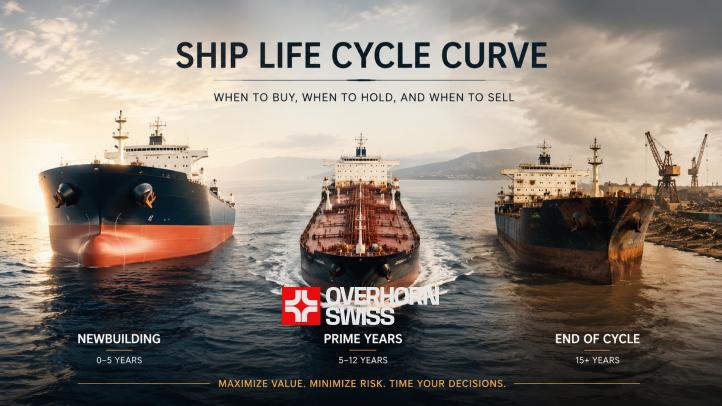
A practical guide for shipowners and investors - no illusions, just numbers.
All vessels are born new. But not all of them die on time
The most costly mistake in shipping is not buying a bad vessel. The most costly mistake is holding a good one for too long. That sounds paradoxical. But that is exactly how even experienced shipowners lose money - not on the way in, but on the way out.
Think of a used car. You know that after 200,000 km, maintenance starts consuming more than the car is worth on the market. A vessel follows the same logic. Except the stakes run into tens of millions of dollars, and the emotional attachment runs even deeper. Because this is not just an asset - it is a fleet, a history, sometimes an entire lifetime.
How do you know where on the curve your asset sits right now? We will walk through each phase - honestly, with numbers, and without unnecessary illusions.
A vessel is not a car. It is a financial instrument with depreciation
Every tanker, bulker, or container ship passes through predictable phases. The average service life of a tanker is 20-25 years. But the devil, as always, is in the details.
The lifecycle curve looks roughly like this:
| Phase | Age | Characteristics |
|---|---|---|
| Newbuilding | 0-2 years | Maximum value, minimum OPEX |
| Prime years | 5-12 years | Optimal balance of value and income |
| Middle age | 12-17 years | Rising OPEX, shrinking charterer market |
| Distressed asset | 17-22 years | High OPEX, limited options |
| Scrap | 20+ years | Scrapping - a financial decision, not a defeat |
The key point to understand: vessel age and vessel value are not a linear relationship. The market, vessel class, type, flag, and maintenance history - all of these shift the curve left or right. A two-year-old tanker may be worth less than a five-year-old one if the newbuilding contract was signed at the top of the cycle and the market has since corrected. Because what buyers purchase is not metal - they purchase yield.
Buying new is about believing in the market, not in the vessel
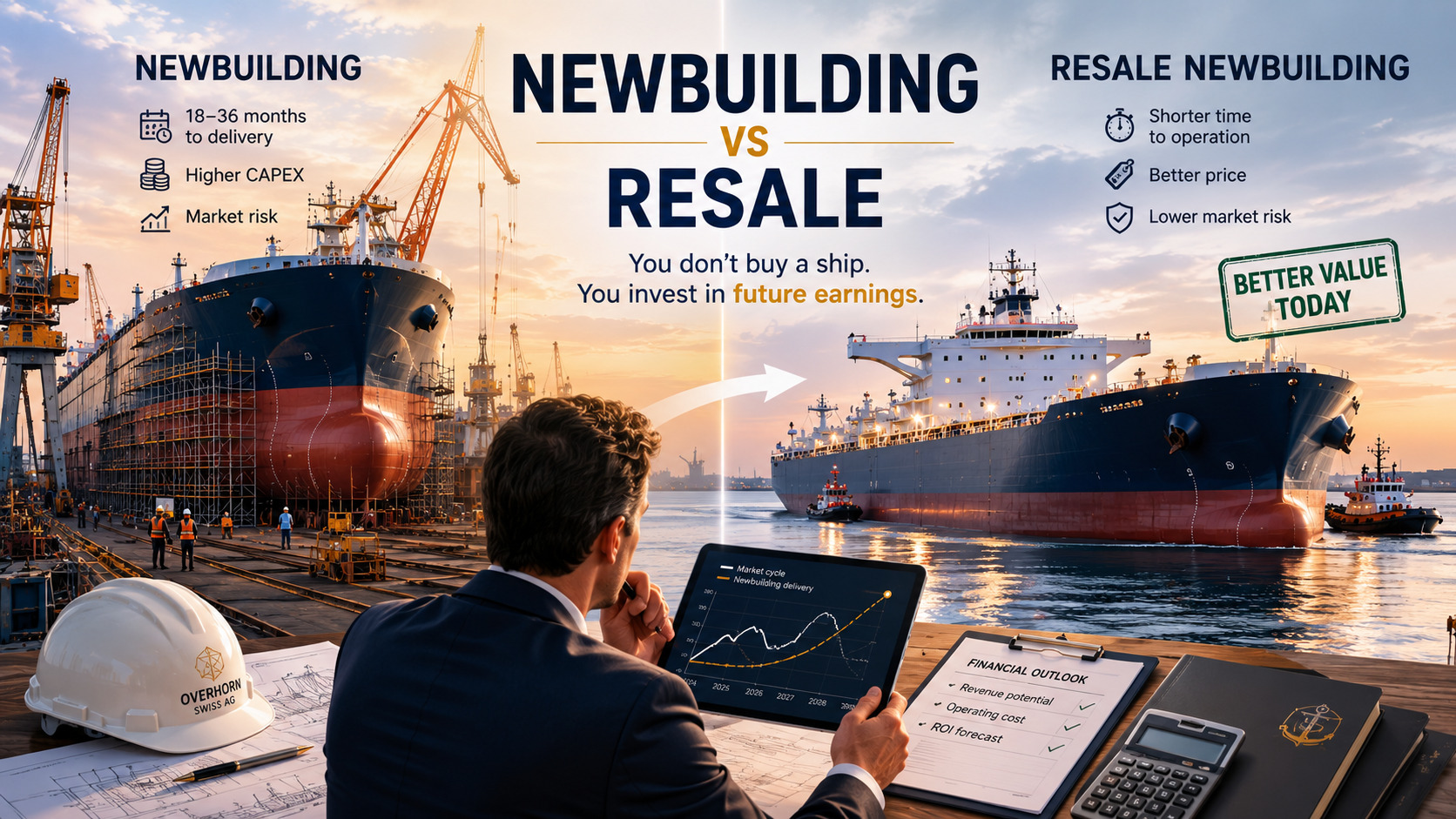
Newbuilding is the most expensive way to enter an asset. Not because the price is higher - though that is also true - but because between signing the contract and taking delivery, 18 to 36 months pass. In that time, the market can turn several times.
When a newbuilding is justified:
- A long-term time charter (TC) from a reliable charterer is in place from the delivery date
- The vessel is being built for a specific operational strategy (fleet renewal, ESG requirements of the financing bank)
- Tax structures are used that make a newbuilding economically preferable
- The yard is offering exceptional terms during a period of low construction demand
When a newbuilding is a trap:
- Buying at the top of the market in anticipation of the spot market - by the time of delivery, rates may be entirely different
- No clear chartering strategy for the first 3-5 years
- Ignoring regulatory risk - CII, EEXI, and EU ETS are constantly reshaping the economics of new vessels
The best alternative at this phase is a resale newbuilding: purchasing a contract from someone who changed their mind or ran into financial difficulty. The vessel is not yet complete, but the price is already lower and the waiting period is shorter. Many investors underestimate this instrument. That is a mistake.
Many shipowners buy a newbuilding the way people buy a flat off-plan - and then wait just as long for the market to "take off." Sometimes they wait longer than the idea itself takes to pay out.
These are the years when the vessel should be earning - not the years when you should be cutting corners
5 to 12 years is the golden period of any tanker. OPEX is predictable and controllable. Major oil companies accept vessels of this age without reservation. Vetting ratings (SIRE 2.0) are high. PSC inspections pass without serious deficiencies.
Optimal strategy during the prime years:
- Maximise TC coverage - lock in rates for long periods while the market allows
- Avoid excessive spot exposure without a liquidity buffer in reserve
- Invest in technical condition - preventive maintenance in this phase costs 3-4 times less than repairs in the next one
- Monitor CII rating - a vessel with an A or B rating commands a significantly higher price on subsequent sale
Key KPIs of a healthy vessel in this phase:
| Indicator | Normal range | Warning signal |
|---|---|---|
| Off-hire rate | < 1% | > 2.5% |
| PSC deficiencies | 0-2 per inspection | Detention or >5 deficiencies |
| CII rating | A or B | D or E (commercial restrictions apply) |
| SIRE 2.0 findings | < 5 observations | Recurring findings in the same categories |
The key nuance of this phase: do not fall in love with the asset. If the market is at its peak and the vessel is commanding an anomalously high price, that is not a reason to hold out of loyalty to the fleet. That is a reason to pick up a calculator. The next peak like this may arrive when the vessel is at a much less favourable stage of its lifecycle.
This is precisely where - at the point when the vessel looks perfect - professional asset identification and thorough due diligence deliver maximum value. The market is flooded with "attractive" offerings that conceal hidden technical histories. A single properly conducted technical survey can shift the price of a deal by millions of dollars.
This is where the real work begins. And the real decisions
12 to 17 years is the most demanding period. The vessel is still operating. Still earning. But it is already beginning to cost more to maintain and worth less on the market.
What happens in this phase:
- Drydock costs increase with each scheduled docking - the 3rd and 4th special surveys are significantly more expensive than the first two
- Aging equipment requires replacement: pumps, separators, navigation systems, inert gas systems
- CII rating inevitably deteriorates - without costly upgrades (scrubber, energy-saving devices)
- EU ETS makes older vessels more expensive to operate: high fuel consumption means high carbon allowance costs
- Major charterers impose age restrictions - typically 15-20 years depending on vessel type and oil company
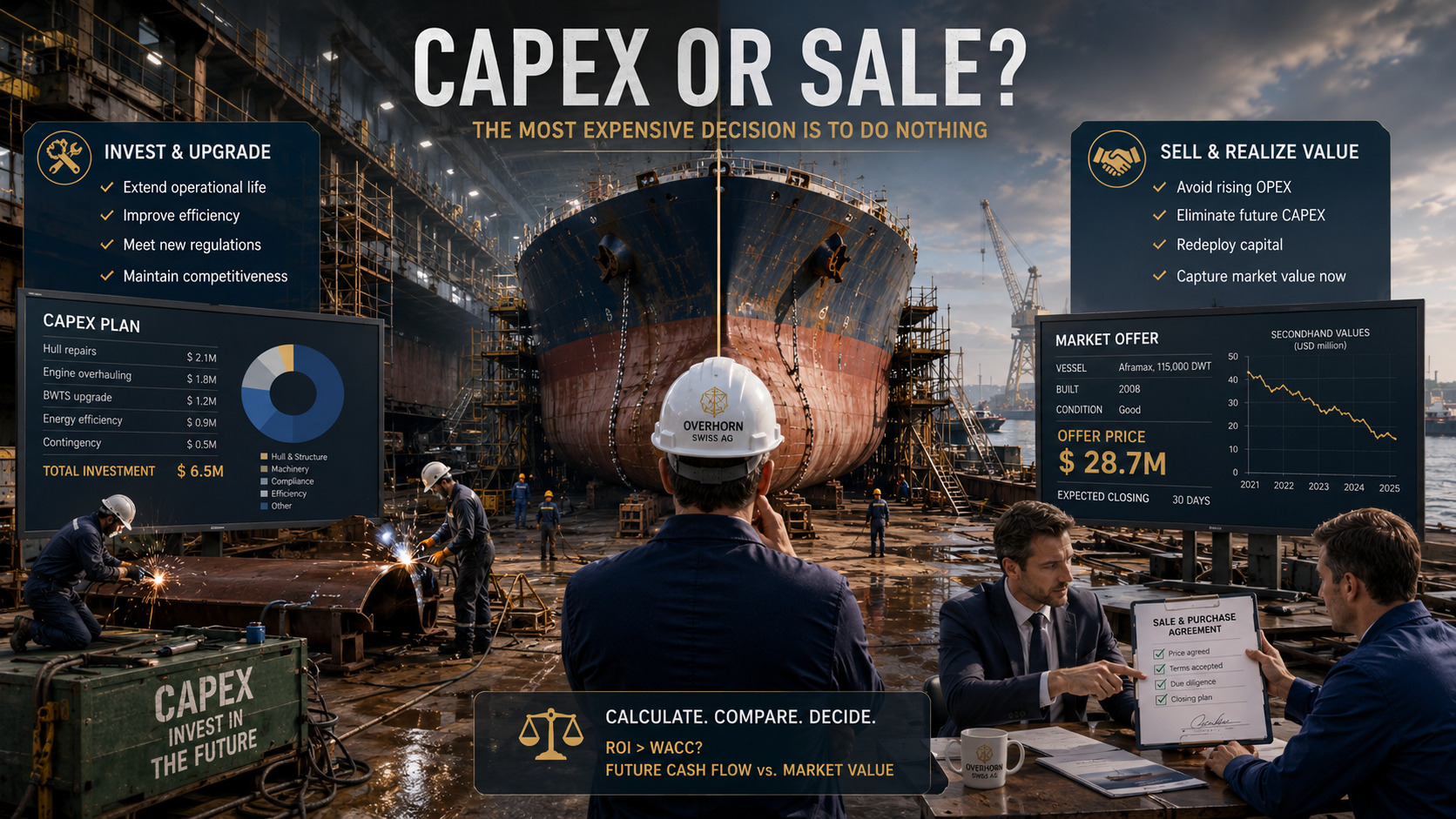
The critical question of this phase: CAPEX for upgrades, or sell now?
The straightforward calculation logic:
- Estimate the cost of upgrades (scrubber installation, BWT system, hull coating)
- Calculate the discounted residual income over the remaining operational period
- If the cost of upgrades exceeds that income - sell. Immediately.
This is precisely the point where most shipowners make the most expensive decision of all - to do nothing. Simply because everything is still working. Because "one more voyage." Every month of delay narrows the selling window and reduces the asset's price.
The vessel is still sailing. But no longer for you - for the next owner or for the scrapyard
In the 17-22 year phase, a vessel enters the distressed asset zone. Commercial options contract sharply, and the cost structure becomes uncomfortable.
Characteristics of this phase:
- OPEX is abnormally high - insurance premiums rise with age, crew demand supplements for working on an ageing fleet
- The pool of available charterers shrinks dramatically - what remains are second-tier traders and less demanding cargo owners
- Sanctions risk increases - older vessels more frequently migrate to the "shadow" fleet, creating compliance risk for banks and insurers
- Classification starts to "press" - surveyor recommendations become more costly and extensive
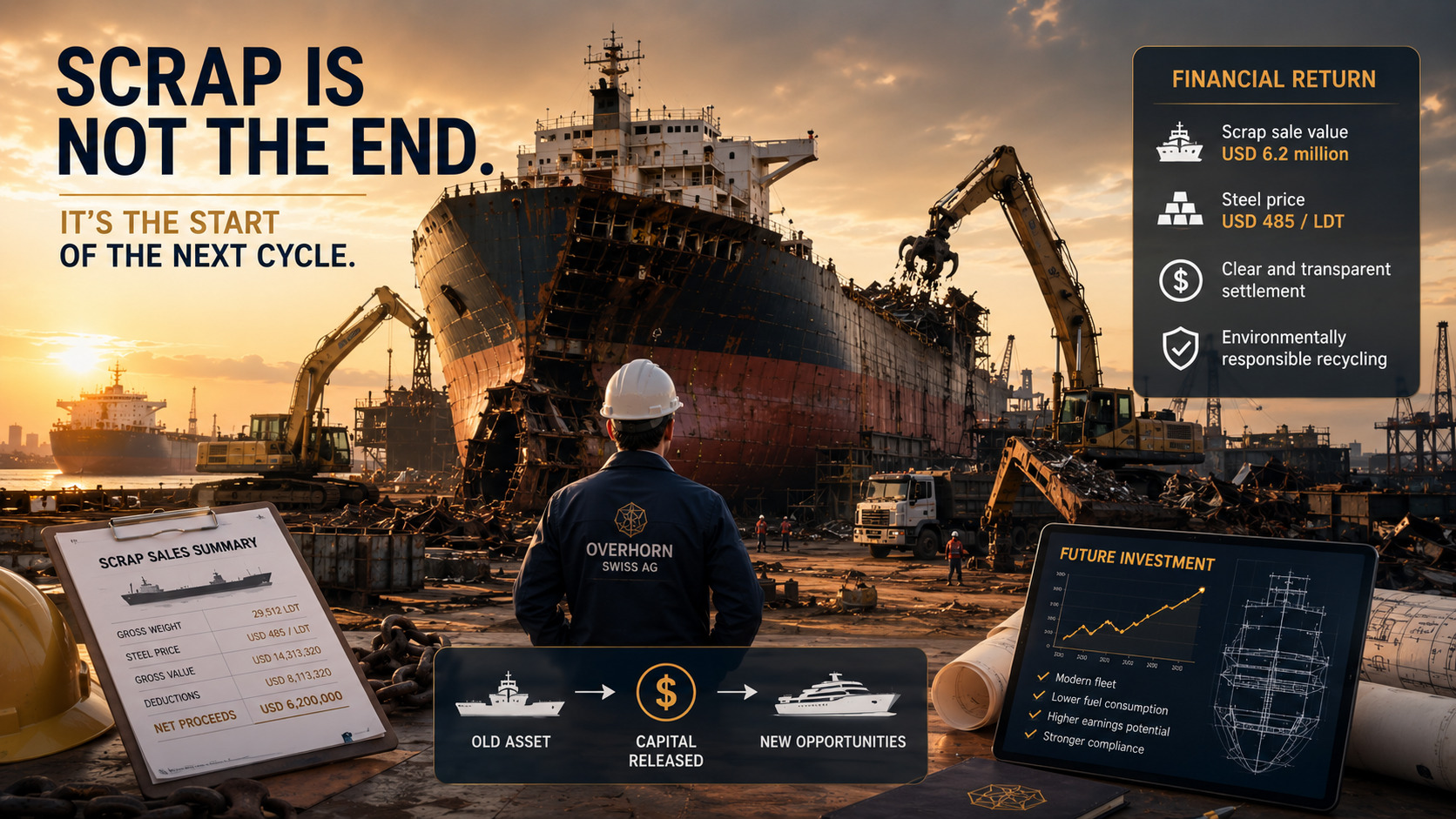
How scrap value (the asset's floor price) is calculated:
LDT (Lightweight Tonnage) × Current scrap price ($/LDT)
Scrap prices at the main dismantling centres (Alang, Chittagong, Gadani) range from $450 to $650 per LDT depending on market conditions and exchange rates.
When holding is still worthwhile:
- The market is experiencing an anomalous spot spike (as in 2022, when sanctions-driven chaos created enormous demand for non-standard tonnage)
- There is a specific charterer for a short voyage at a good rate
- The vessel is being used for floating storage - a separate scenario with its own economics
When to sell immediately:
- Scrap value plus transaction costs exceeds the projected TCE income for the next 12 months
- Freight rates in the market are beginning to fall - scrap buyers will lower their price in line with the market
- The next drydock requires investment that will not be recovered over the vessel's remaining operational life
It is important to remember: the selling window closes quickly. When freight rates fall, recyclers reduce their offers at the same time as traders do. Delay at this point costs money every month.
Scrapping a vessel is not a defeat. It is a financial decision
The demolition market is a separate industry with its own logic. Three main recycling centres:
| Facility | Country | Key features |
|---|---|---|
| Alang | India | The largest centre, with stricter standards following the Hong Kong Convention |
| Chittagong | Bangladesh | Traditionally the highest prices, but also the greatest environmental concerns |
| Gadani | Pakistan | Lower volume, often used for specialist tonnage |
The optimal moment to scrap is when freight rates are high. That is precisely when recyclers compete with those who still want to operate the vessel, and they offer maximum prices per LDT.
The legal side of the matter requires attention:
- Hong Kong Convention (a mandatory reference point for shipowners operating within European jurisdictions)
- Inventory of Hazardous Materials (IHM) - mandatory documentation for EU Statement of Compliance
- Flag state: re-flagging to a flag of convenience prior to recycling is a common optimisation practice
- Ship's crew: repatriation, settlement of accounts, compliance with MLC 2006
And the most important thing to keep in mind: the proceeds from scrapping are the seed capital for the next deal. A well-executed exit from an asset is not the end of a fleet. It is the beginning of the next investment cycle. The circle closes.
Three questions to ask yourself every 12 months
Managing a vessel's lifecycle is not a one-time decision. It is a discipline. We recommend that every shipowner and investor answer three questions annually:
- Where is the vessel on the curve - and where is it heading faster than you think? Age is not the only factor. Technical condition, CII trajectory, drydock history - all of these accelerate or slow movement along the curve.
- What is the market saying right now - and is this a cyclical peak or a new normal? A decision to sell during high rates feels counterintuitive. But that is precisely when buyers pay the maximum.
- What is the opportunity cost of the capital locked up in this asset? Sometimes the right question is not "should I sell this vessel," but "what could I buy with that money instead."
A brief checklist of signals for each phase:
| Phase | "Buy" signal | "Hold" signal | "Sell" signal |
|---|---|---|---|
| 0-5 years | Resale at a discount + TC in hand | TC locked in, rates rising | Anomalous premium in the S&P market |
| 5-12 years | Good history, CII A/B, low OPEX | Market rising, TC is favourable | Market peak + attractive S&P price |
| 12-17 years | Rarely - only at an obvious discount | OPEX manageable, TC in place | Drydock costs exceed remaining ROI |
| 17-22 years | Only on a spot spike + short horizon | Anomalous market (2022-type) | Scrap value > TCE over 12 months |
The answers to these questions do not live in Excel. They live in market expertise, access to current brokerage data, and experience from closed deals.
The curve does not wait. Neither does the market
A vessel's lifecycle is not a matter of fate. It is a managed process. With the right decisions made at the right points on the curve, the asset works for the investor, not against them. It is important to understand that every year of delay on a necessary decision is not a "preserved asset." It is lost value.
Vessels that are "still good for a bit longer" are the most expensive vessels in any fleet. You can count on it.
The Overhorn Swiss AG team has closed deals totalling more than $140 million - from resale newbuildings to pre-scrap S&P transactions. We work across all phases of the curve and know where real value hides - and where it quietly slips away.
Want to understand where your asset sits on the curve right now? Let's work through it together.
Office: Werftestrasse 4, 6005 Luzern, Switzerland
Email: info@overhorn.ch
Phone: +41 79 828 07 07


