
 En
En  De
De


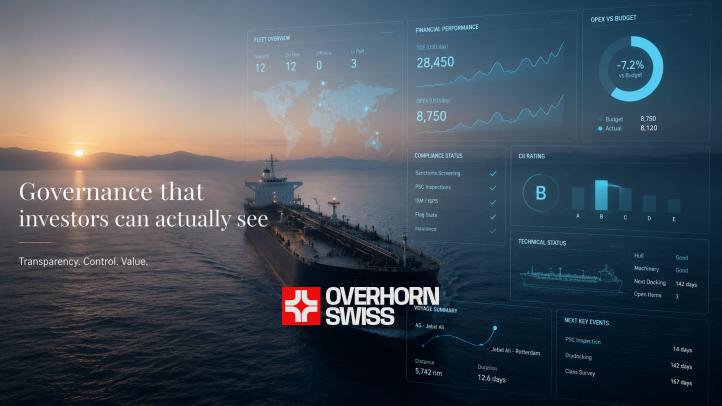
Shipping is widely regarded as an opaque industry. Vessels head out to sea, money arrives in the account - and everything that happens in between is often something the investor learns about after the fact. Yet modern fleet management is not a matter of the captain's instincts or a phone call from port. It is a structured governance stack in which each layer operates independently and reinforces the others. Below is a concrete, no-filler look at how this works at Overhorn Swiss AG.
Why Governance in Ship Management Is Not Bureaucracy - It's Money
There is a fundamental difference between a fleet manager and an asset manager. The first makes sure the vessel sails. The second makes sure the vessel creates value - and protects that value at every stage of its life cycle.
When transparency is absent, the investor loses on three fronts simultaneously:
- NAV control. Without up-to-date data on OPEX and technical condition, it is impossible to accurately assess the market value of the asset. This directly affects debt raising and the price at exit.
- Compliance protection. In 2024-2025, sanctions enforcement in the tanker sector reached an unprecedented level. A single wrong voyage and the vessel loses its vetting accreditation, insurance, and access to most terminals.
- Exit liquidity. In an S&P transaction, the buyer's first request is the maintenance history, PSC inspection logs, and financial statements. Without them, a discount is inevitable.
A good manager shows their worth not on a sunny day, but in a storm.
What a "Governance Stack" Is - and Why the Term Fits Here
In IT architecture, a stack is a set of technologies where each layer performs its own function and reinforces the adjacent one. No layer duplicates another, but if one drops out, the system loses its stability. The logic is identical in the corporate management of a shipping asset.
The Overhorn stack consists of three layers:
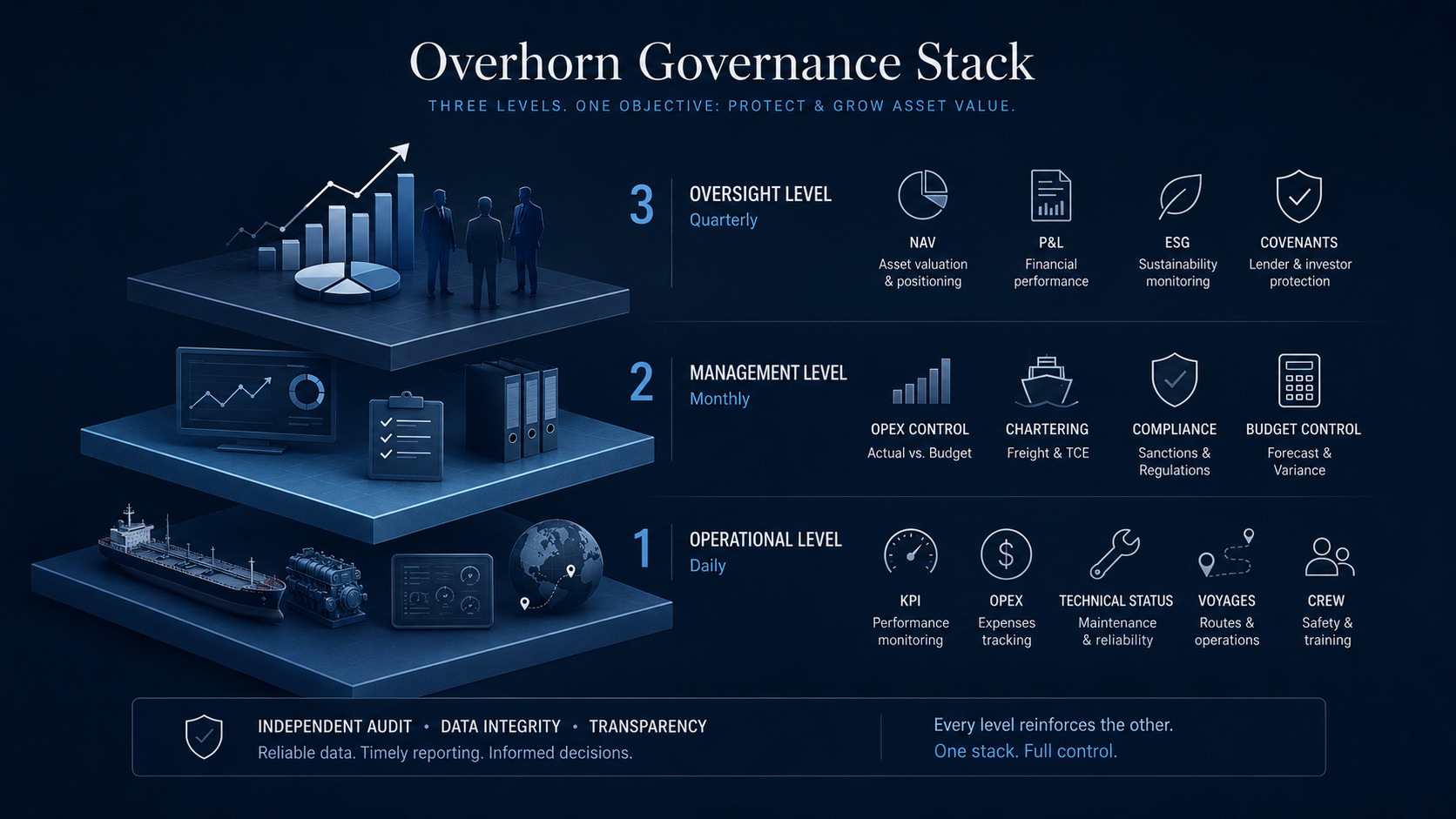
| Layer | Horizon | What Is Monitored | Who Receives the Data |
|---|---|---|---|
| Operational | Daily | Vessel KPIs, expenses, technical condition, voyages | Overhorn team |
| Management | Monthly | OPEX actual vs. budget, freight, compliance | Client / shipowner |
| Supervisory | Quarterly | P&L, NAV, covenants, ESG, forecast | Investor / lender |
Why not one consolidated report once a year? Because in shipping, a year is too long. The freight market shifts within weeks. A technical problem identified in March costs $50k. The same problem discovered in December means an unplanned docking and $300k lost to downtime.
Monthly Dashboards: What's Inside and Why It Matters to the Investor
A dashboard is not an Excel file attached to an email. It is a decision-making tool designed to answer one question: "Is everything on track, and if not - where exactly?"
Every month, an Overhorn client receives a structured data package across four blocks:
Financial Block
- OPEX actual vs. budget broken down by line item (crew, lubricants, maintenance, insurance, administration)
- Variances with an explanation of causes - not just a number, but context
- OPEX forecast for the following month, accounting for planned work
Technical Block
- The vessel's CII rating (current and projected to year-end)
- Planned vs. unplanned repairs: status, cost, timelines
- Results of PSC inspections and vetting audits for the period
- Status of class and flag certificates
Freight Block
- Vessel position: TC or spot, TCE rate, comparison with market benchmark (BDTI/BCTI)
- Uptime and idle days for the month
- Forecast for the next voyage / negotiations on the next charter
Compliance Block
- Sanctions screening of counterparties (OFAC, EU, UK)
- Status of ISM/ISPS documentation
- MLC 2006 - crew compliance
Consider an example: OPEX growth of 8% against budget - is it a warning signal or within the norm? It depends on the cause. If it is a planned main engine overhaul, everything is fine. If it is an unplanned repair to the steering gear, then preventive maintenance has not been carried out properly. The dashboard makes this visible in the current month, rather than surfacing the problem six months later in the financial statements.
This is what Overhorn calls data-driven agile decisions - not a marketing phrase from the website, but a monthly management practice.

Independent Audit: Who Checks the Manager
A natural question arises here, one that every experienced investor asks: who checks the manager himself? Internal controls are good, but they are not enough. Conflicts of interest do not disappear simply because the manager is conscientious.
Independent audit in ship management covers several key areas:
| Audit Area | What Is Verified | Why It Matters |
|---|---|---|
| Financial accuracy | OPEX expenses vs. source documents, absence of hidden markups | Protection against inflated costs |
| ISM/ISPS | Safety procedures, drill logs, SMS documentation | Insurance and legal compliance |
| Sanctions screening | Counterparties, ports, cargoes, charterers (OFAC, EU, UK) | Critical in 2024-2025 for the tanker sector |
| Crew management | MLC 2006: contracts, wages, working conditions, repatriation | Protection against vessel detention in port |
The Swiss jurisdiction is not merely a prestigious line in an address. It means a specific standard: mandatory financial reporting, strict corporate procedure requirements, a neutral legal environment. For a foreign investor placing $10-50 million into a shipping asset, this matters more than it might initially appear.
An audit is not a punishment. It is what distinguishes a partner from an intermediary.
The Quarterly Investor Report: What It Contains and in What Format
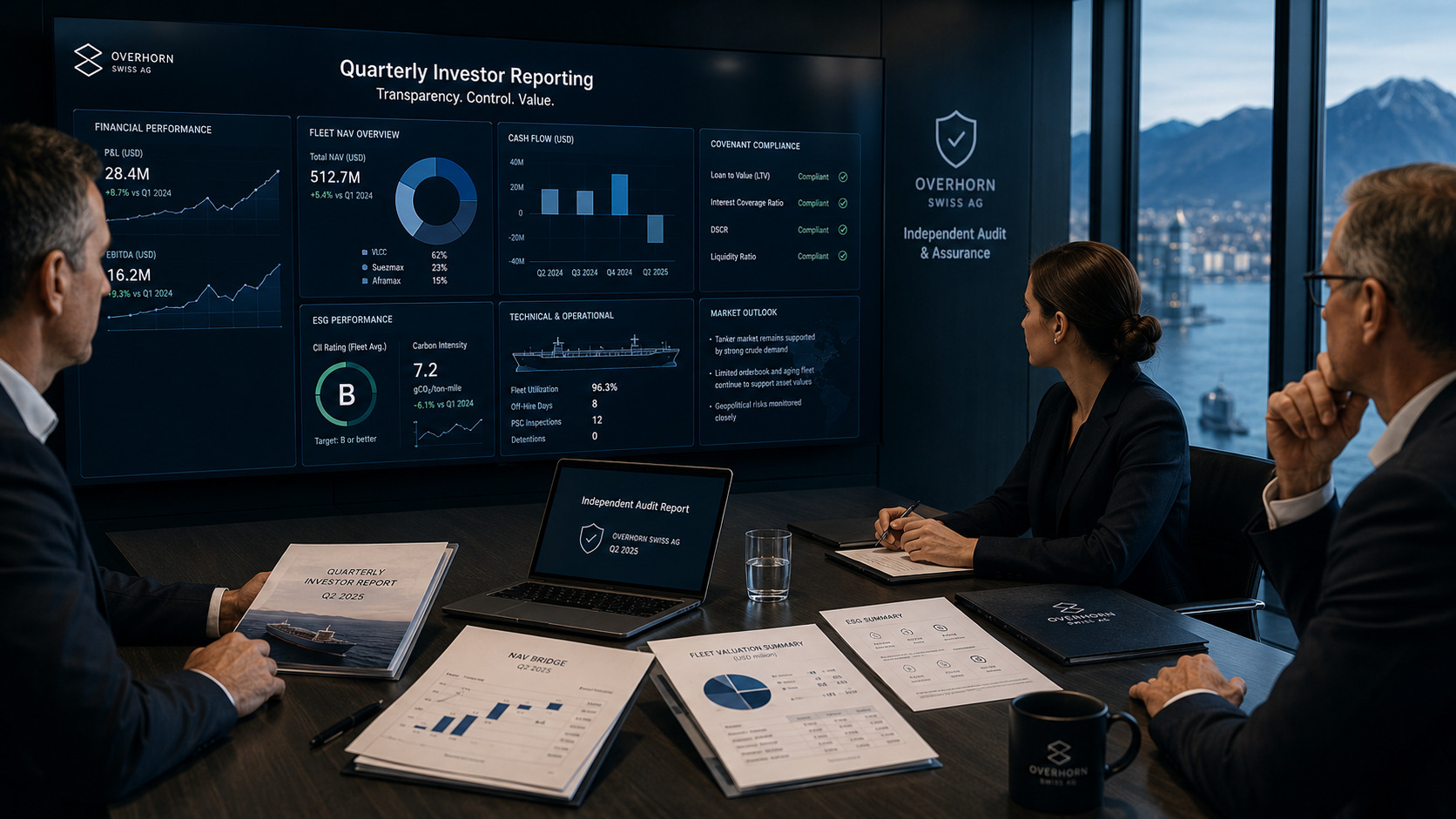
Once a quarter, the investor receives a full financial cross-section of the asset. This is not a retelling of monthly dashboard data - it is a strategic document on the basis of which decisions are made about refinancing, adding to a position, or exiting it.
The standard Overhorn quarterly package includes:
- Vessel / portfolio P&L. Revenue (TCE), expenses (OPEX), net result for the quarter and on a cumulative year-to-date basis.
- NAV valuation. Market value of the asset as of the reporting date (with reference to broker valuations) vs. outstanding debt. Net value of the investor's position.
- Cash break-even vs. actual TCE. How far the vessel is "in the money" relative to the break-even point. The key metric for lenders.
- Covenant status. If the asset is leveraged - compliance with all financial covenants (LTV, DSCR, minimum liquidity).
- ESG metrics. CII rating at quarter-end, year-end forecast, corrective action plan where necessary. Carbon footprint of voyages. Social compliance for the crew.
- Scenario forecast. Three scenarios for the next quarter: base, optimistic, stress - with sensitivity to changes in freight rates and OPEX.
After receiving such a package, the investor should have decisions, not questions. If a report generates more questions than answers, that is a signal about the quality of management - not about the complexity of the industry.
$300M+ under Overhorn's management is not a marketing figure. It is accountability for quarterly reporting to real people who have invested real money.
How This Looks in Practice: From the First Call to the First Dashboard
Governance is not built at the moment a vessel is handed over for management. It is built from the very first contact - and this is precisely where the manager's true level becomes apparent.
A typical Overhorn client journey looks like this:
- Initial Inquiry. The investor or shipowner describes the asset or portfolio, the planning horizon, and the objective (yield, optimization, preparation for sale). Already at this stage, Overhorn conducts a preliminary baseline screening: the asset's sanctions status, current CII rating, and open deficiencies from recent inspections.
- Tailored Proposal. A customized commercial proposal with a clear description of the governance structure: which reports, at what frequency, who the independent auditor is, and which KPIs are considered target for the given vessel type.
- Cooperation. Onboarding takes 2-4 weeks. During this period, a technical audit of the vessel is conducted, a baseline is established for all key metrics, and dashboards are configured. The client receives the first monthly report at the close of the first full calendar month under management.
Asset management does not begin with the purchase of a vessel. It begins with the choice of manager - and with how transparently that manager is prepared to work from day one.
Conclusion
Three stack layers, three horizons of visibility. Daily operational data gives the team the ability to respond quickly. The monthly dashboard gives the client confidence that the asset is being managed correctly. The quarterly package gives the investor a basis for strategic decisions. Independent audit closes the control loop.
This is not excessive bureaucracy. It is the minimum necessary infrastructure for a shipping asset worth $15-50 million to behave like an investment instrument rather than an opaque bet on luck.
Good management goes unnoticed. Bad management is never forgotten.
If you are considering placing an asset under management or would like to discuss a governance structure for your portfolio, the Overhorn Swiss AG team is ready to talk.
info@overhorn.ch · +41 79 828 07 07 · Werftestrasse 4, 6005 Luzern, Switzerland


