
 En
En  De
De


A non-standard cargo is not simply a hazardous cargo. It is a cargo with unpredictable behavior. And it is precisely this nuance that separates operators who cope from those who end up in court.
Where It All Begins
Once, in the port of Rotterdam, a vessel carrying acrylonitrile sat at the berth for an extra 36 hours - not because of weather, not because of a technical fault. The cause was a discrepancy between the cargo temperature at the time of loading and the permissible range specified in the IBC Code. The charterer was pressing. The broker assured everyone that "everything was fine." The master had doubts. The technical manager did not answer the phone in time.
How did the story end? The vessel did sail. Without incident. But solely because the chief officer insisted on a repeat measurement and recorded everything in the ship's log. One person. One correct step. And not a single system in place to support him.
This article is about that system. We will examine real cases, discuss the economics of complex cargo, and explain why 30 years of practice ultimately leads to one conclusion: complex cargo demands not heroism, but a system.
A non-standard cargo is not simply a hazardous cargo in the IMO sense. It is any cargo whose behavior cannot be fully predicted on the basis of standard documentation. And in real practice, such cargoes are the majority.
What "Non-Standard Cargo" Actually Means
Many operators are misled from the outset by the official classification. After all, "hazardous cargo" in the IMO sense is a clearly defined category with prescribed rules. However, real complexity in shipping rarely coincides with what is written in the reference manual.
In practice, we identify four categories of complexity, and they differ from one another in fundamental ways:
| Category | Examples | Why It Is Complex |
|---|---|---|
| Physical | Molten sulfur, bitumen, viscous oils | Require temperature control, specialized equipment, and specific discharge procedures |
| Chemical | Acrylonitrile, styrene, acids, peroxides | Reactivity, volatility, incompatibility with residues of the previous cargo |
| Regulatory | Dual-use goods, sanctioned routes | Conflicting requirements of the flag state, the port of discharge, and the actual cargo |
| Human | Any cargo handled by an inexperienced crew or under charterer pressure | Misinterpretation, language barriers, fatigue, commercial pressure |
And here is what is important to understand: a "standard" cargo becomes non-standard under the wrong conditions. Palm oil is an ordinary commodity for the food industry. But at an incorrect storage temperature it crystallizes, solidifies in the tank, and turns the discharge into an emergency operation. The issue is not the cargo classification. The issue is the combined set of conditions of the voyage.
Chemical Cargo: Where Theory Diverges from Practice
Handling chemical cargo by the book is necessary, but not sufficient. The book describes ideal conditions; a voyage takes place in the real world.
Case 1 - Acrylonitrile and an Unstable Temperature Regime
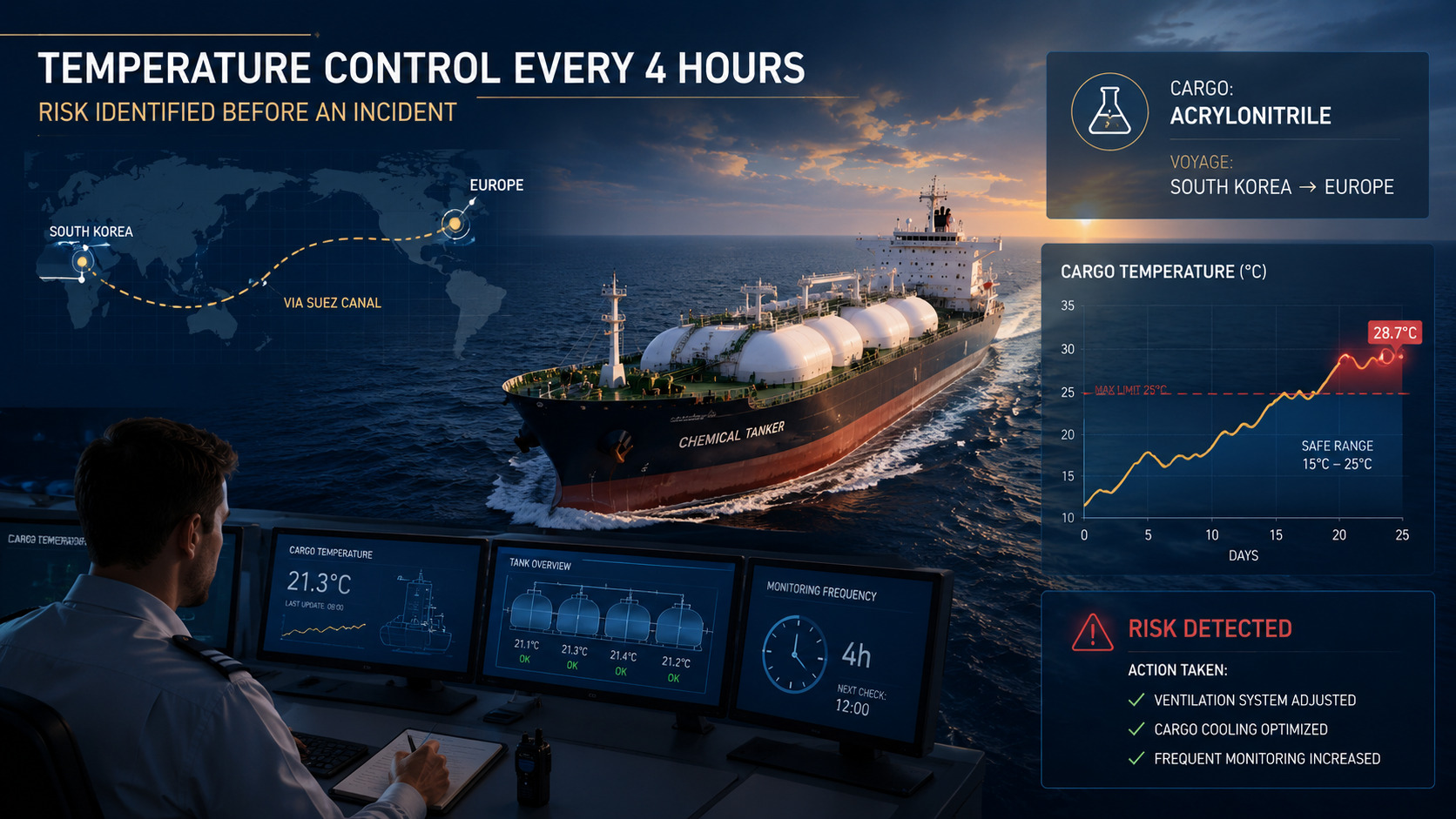
A vessel took on a cargo of acrylonitrile in South Korea for delivery to the Netherlands. The cargo was accepted within the permissible temperature range. However, during the passage through the Indian Ocean the sea water temperature proved higher than calculated - the vessel was sailing during a period of abnormal heat. The tank cooling system was operating at its limit.
The problem surfaced not at the moment of critical overheating, but one step earlier - because the chief officer was tracking the temperature trend every 4 hours rather than once a day as the minimum standard required. This allowed time to adjust speed and route.
Conclusion: The standard monitoring interval is the minimum permissible threshold, not the optimal one. For volatile and reactive cargoes we recommend doubling the frequency of measurements on critical sections of the route.
Tank washing and the reactivity of residues is a separate matter. This is perhaps the most underestimated source of risk in the carriage of chemical cargo. Operators focus on the new cargo, forgetting that the tank always carries a history.
Incompatible residues from a previous cargo, when interacting with a new one, can produce:
- Polymerization (characteristic of styrene, acrylonitrile, VCM)
- Release of toxic gases
- Corrosion of the tank coating
- Contamination of the cargo with loss of its commercial value
What does real compliance look like - not in a textbook, but on board? MARPOL, IMDG, and the IBC Code exist in parallel realities: the document is written, the procedure is set out, yet in practice the master simultaneously receives conflicting instructions from the DPA, the charterer, and the port agent.
What the Technical Manager Must Verify Before Loading
- Compatibility of the new cargo with residues of the previous one - using the official compatibility table in the IBC Code, not by eye
- Validity of the tank coating certificates - for acids and solvents this is critical
- Compliance of the vessel's temperature-control equipment with the requirements of the specific cargo lot, taking into account the route and the season
A SIRE inspection is a separate matter. The inspector sees the equipment, the documentation, and the procedures. He does not see how the crew behaves at 3 a.m. during a non-standard situation. This is precisely why a SIRE result does not equal real safety. A good rating is a necessary condition for working with major traders, but not a guarantee of an incident-free voyage.
When the Charterer Presses and the Master Has Doubts
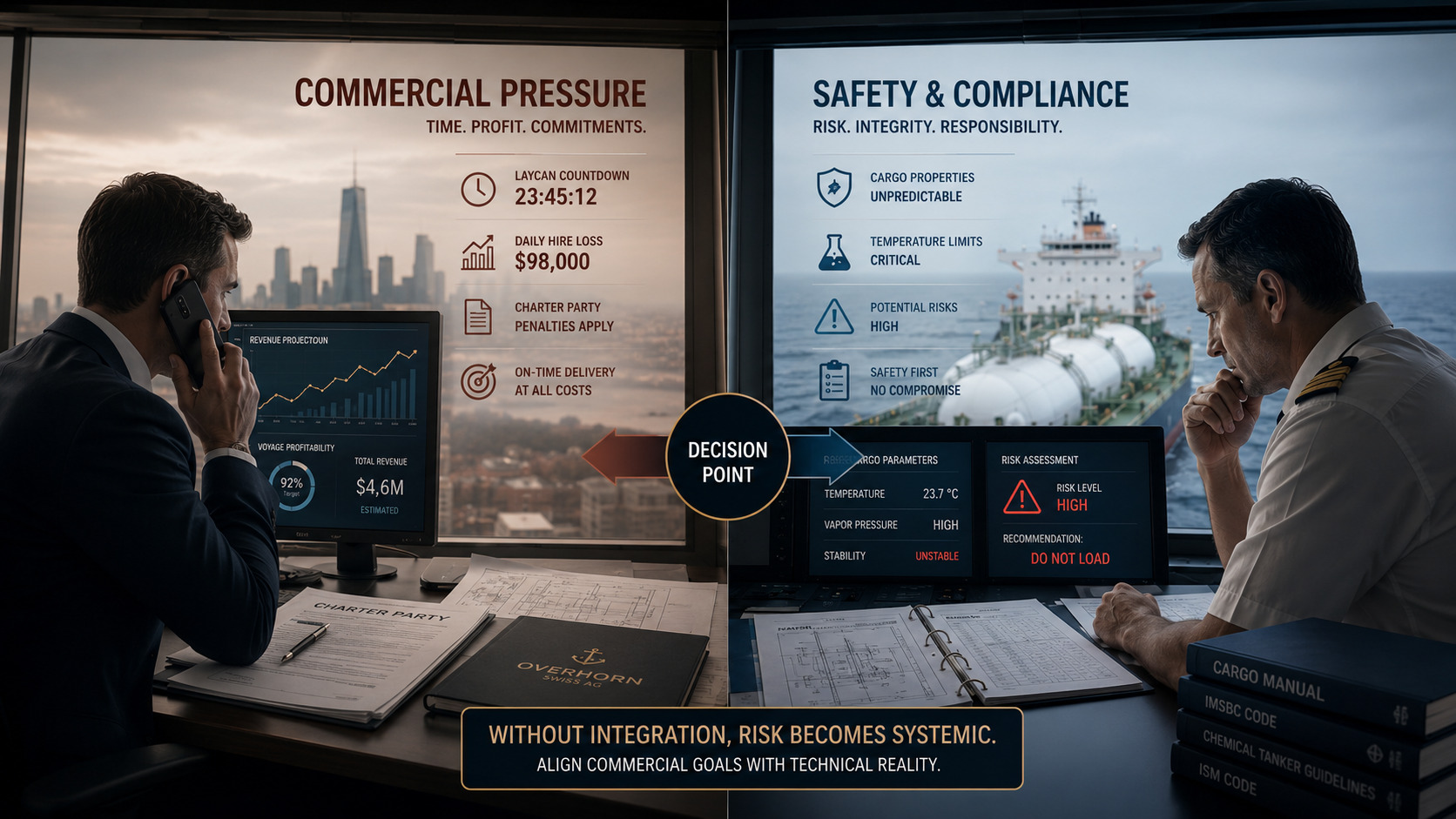
This is the most painful scenario in our practice. And, unfortunately, one of the most common. Commercial pressure is not an abstraction. It is a specific person at the other end of the phone reminding you of the laycan, the penalties for delay, and the fact that "other vessels carry this cargo without any problem."
Case 2 - TCE Against Safety: What Happens Without Integration
A chemical tanker fixed a time charter with an obligation to present at the loading port within 48 hours. Twelve hours before presentation it emerged that the cargo contained an impurity placing it outside the class specified in the charter. The technical manager received the information in time. The commercial manager did not. The decision to sail was taken by the commercial team before the technical manager had time to escalate the issue.
The result: the vessel sailed, the cargo was accepted in breach, and the P&I club partially declined coverage when a subsequent claim arose.
Conclusion: The gap between commercial and technical management costs money. Sometimes - a very great deal of money.
The correct decision chain in such a situation looks like this:
- The master records the deviation and immediately notifies the DPA and the technical manager
- The technical manager assesses the risk and prepares a position in writing
- The commercial manager receives the technical team's position before any negotiations with the charterer
- The joint decision is recorded in documentary form - with time stamps
- The charterer receives a response based on the technical position, not on commercial preferences
Integration of commercial and technical management is precisely what in practice separates first-tier operators from all the rest. In our work we build this integration as a basic architecture, not as an option.
Documentation as protection. Every deviation from a standard procedure must be recorded: who made the decision, on what grounds, and at what time. This is not bureaucracy - it is the only thing that holds up in a dispute with a P&I club or a port inspection.
Specialized Cargo: A World Apart
Chemical tankers are one reality. But specialized cargoes beyond that world - sulfur, bitumen, vegetable oils, liquefied gases - are an entirely different universe. With their own rules, their own risks, and their own surprises.
Case 3 - Sulfur: When the Cargo Solidifies Ahead of Time
Molten sulfur is carried at a temperature of 130-150°C. Below 119°C it solidifies. Heated above 160°C it polymerizes and becomes viscous, virtually impossible to pump. This is a narrow temperature window.
In one of our cases, during a passage through the North Sea, one of the three heating coils in a tank failed. The temperature began to fall. The crew redistributed the load across the remaining coils and simultaneously reduced speed, shortening the time spent in the risk zone. The cargo was delivered without loss. But this was possible solely because the crew understood the behavior of sulfur not from an instruction manual, but from practical experience.
Conclusion: For sulfur, bitumen, and other cargoes with a narrow temperature window, the availability of backup heating systems is not an option but a mandatory condition of fixing the voyage.
Case 4 - Palm Oil and a Surprise at the Port of Discharge
A cargo of palm oil was accepted in Malaysia for delivery to a European port. All certificates were in order. MARPOL was complied with. The documentation was complete. At the port of discharge it emerged that the buyer required RSPO (Roundtable on Sustainable Palm Oil) certification, of which there had been no mention in either the charter or the bill of lading. Discharge was delayed for four days.
Demurrage fell on the shipowner - because it was he who, in the charterer's view, was obliged to "know about market requirements."
Conclusion: For agricultural and food cargoes, the certification requirements of the country of destination must be verified at the fixing stage - not at the port of discharge.
What is never written in the charter but always matters:
- The actual capacity of the berth to receive a specific cargo type
- The real pump rate of the terminal (not the nominal one)
- Certification requirements that the cargo buyer imposes only after fixing
- Local environmental restrictions not reflected in global conventions
The role of an experienced supervisor on board during non-standard cargo operations is not over-caution. It is an investment with a measurable return. The cost of one day of a supervisor is incomparably less than the cost of one day of delay or one cargo contamination incident.
The OPEX Logic of Non-Standard Voyages
This is where most investors and operators make a systematic error. A non-standard cargo looks attractive at the level of the freight rate. Specialized transport does indeed command a premium over the market. However, the real economics of the voyage look different.
Hidden Cost Items Invisible at Fixing
| Cost Item | Standard Cargo | Non-Standard Cargo |
|---|---|---|
| Tank cleaning | Standard washing | Multi-stage flushing, solvents, independent inspector |
| Certification | Basic certificates | Specialized class certificates, additional flag-state approvals |
| Personnel | Standard manning | Additional officer with chemical training (STCW V/1-1) |
| P&I insurance | Standard rate | Cargo category surcharge, additional clauses |
| Delays | Rare with standard cargo | Frequent - for regulatory, documentary, and technical reasons |
| Equipment repairs | Planned | Accelerated wear of heating systems, coatings, and pumps |
The mistake investors make is looking at the freight rate without seeing the cost of complexity. The premium exists. But it exists precisely because most operators are unable to manage that complexity effectively.
The correct formula for deciding whether to fix a non-standard cargo includes:
- Calculating the full voyage OPEX taking all specialized costs into account
- Assessing the probability and cost of delay at key ports on the route
- Analyzing the condition of the vessel's equipment in relation to the requirements of the specific cargo
- Evaluating crew competence - not on paper, but in fact
- Calculating the actual TCE with all factors included - and only then comparing with alternative options
When is it worthwhile to take such a cargo? When the vessel has the right equipment, a trained crew, and established procedures - and when all these factors are reflected in the fixing price. When is it not worthwhile? When the marginal premium to the market is 8-12% and the risk of delay or incident is capable of wiping out the profit from several subsequent voyages.
Compliance as a Competitive Advantage, Not a Burden
The attitude toward documentation changes exactly once - after the first serious incident. Until that moment, compliance is perceived as an administrative burden. After it - as the safety net that one was reluctant to put in place.
Flag states are not equal. This is obvious to any experienced operator, but is regularly overlooked when structuring new assets. The difference in weight between a first-register flag and a flag of convenience manifests itself precisely when handling complex cargo - during a PSC inspection, in negotiations with a major trader, and at the moment of an incident.
How Vetting Works in Practice
Major oil and chemical traders - Shell, BP, Total, BASF - filter out vessels before freight negotiations even begin. A vessel with an unsatisfactory SIRE result or a history of PSC detentions simply does not make it onto the approved tonnage list. This means:
- Automatic exclusion from working with premium cargoes
- Operating exclusively in the second-tier spot market
- Substantially lower freight rates over the long haul
- A reduction in the asset's market value upon sale
Thirty years of practice means 30 years of working with regulatory change. The major shifts we have observed: the tightening of MARPOL Annex II regarding chemical cargoes, the introduction of IBC Code amendments, and the growth in environmental documentation requirements. On the horizon now - CII requirements linked to specialized shipping.
What will CII change for operators of non-standard cargo? A great deal. Chemical and specialized voyages often involve non-standard routes, ballast passages, and slow-speed operations to maintain cargo temperature. All of this affects the Carbon Intensity Indicator. Operators who build a CII management strategy now will gain a competitive advantage after 2027.
The Human Factor: The Most Non-Standard Cargo of All
A vessel can be perfect, the documentation impeccable, and the cargo correct. And still produce an incident - if the crew is not prepared or is operating under conditions of chronic overload.
Case 5 - Language Barrier and a Misunderstood Instruction
On a chemical tanker with a multinational crew, instructions were received for washing a tank after the discharge of methanol. The instruction was in English. The boatswain, who was directly supervising the operation, interpreted "flush with water - 3 cycles" as "flush with water once, then check twice more." In practice this meant a single flush instead of three.
Methanol residues in the tank were discovered by the terminal inspector during the next loading. The vessel was turned away from the berth. The losses: two days of off-hire, re-certification of the tank, and reputational damage with the terminal.
Conclusion: Critical instructions for a multinational crew must be accompanied by visual diagrams and control checklists signed by the responsible officer. The language of the instruction is not a formality.
Manning policy for chemical tankers is a discipline in its own right. The qualifications of officers with advanced chemical cargo training (STCW V/1-1, Advanced) cost more. But cutting crew costs when handling complex cargo is a false economy. A single cargo contamination incident costs more than the difference in wages over a year.
The Triad That Precedes Incidents
- Fatigue - chronic understaffing of the crew on demanding voyages
- Stress - commercial pressure transmitted to the vessel through the master
- Time pressure - laycan, demurrage, an impatient trader at the other end of the phone
How to break this triad? Systematically. A clear boundary: commercial pressure stays between the manager and the charterer and is not transmitted on board in the form of informal "requests." The master makes safety decisions without commercial context. The DPA is available 24/7 - not formally, but in reality.
The Investor's Perspective: What You Are Really Investing In
A chemical tanker or specialized fleet is an attractive asset on paper. Higher freight rates, longer charters, a more resilient market during periods of volatility. All of this is true. However, an investment in specialized tonnage requires an understanding of several things that are not always obvious before the moment of purchase.
What to Examine During Due Diligence on a Chemical Tanker
| Parameter | What to Look For | Why It Matters |
|---|---|---|
| SIRE/CDI history | Number and nature of observations over the last 3 years | Predicts accessibility to premium traders |
| PSC history | Detentions, deficiencies, flag, and ports of inspection | Directly affects the asset's market value |
| Tank coatings | Coating type, age, certification for specific cargoes | Determines cargo flexibility and CAPEX for repairs |
| Reputation in databases | Equasis, Lloyd's MIU, traders' internal databases | An invisible factor that genuinely restricts or expands the market |
| Manning history | Crew turnover, qualifications of key officers | An indicator of the real operational culture on board |
| OPEX structure | Actual expenditure over the last 2-3 years, not budget figures | Allows a true assessment of the asset's profitability |
Three questions an investor must ask the management company before signing:
- What is the history of deviations from the OPEX budget over the past three years, and what explains them?
- What is the company's policy when there is a conflict between commercial pressure and the master's technical position?
- What does voyage reporting look like - in what format, how frequently, and what KPIs are included?
Transparent P&L and data-driven reporting are not merely a convenience. They are the only instrument that allows an investor to see the real picture, rather than the one the manager is willing to show on a quarterly call. The difference between these two pictures is sometimes millions of dollars.
30 Years: What Has Remained Unchanged and What Has Changed Completely
Technology has changed. The regulatory environment has changed. Freight markets have become faster and less predictable. Fleets have become more specialized. Traders have become more demanding. Investors more sophisticated.
What has not changed in 30 years of practice:
- The nature of human error - the mechanisms are the same as in the 1990s
- The logic of commercial pressure on the master - only the channels have become faster
- The value of experience in non-standard situations - no algorithm can replace a person who has already seen this once before
- The fundamental role of documentation as the only protection in a dispute
What has changed fundamentally:
- The speed of information - an incident on a vessel becomes known to the trader before the master has time to reach the DPA by phone
- Regulatory density - the volume of requirements has grown by an order of magnitude
- The role of data - what was once the intuition of an experienced manager can and should today be backed by analytics
- Vetting requirements - what 20 years ago was considered a "good" vessel would not pass the initial screening of a major trader today
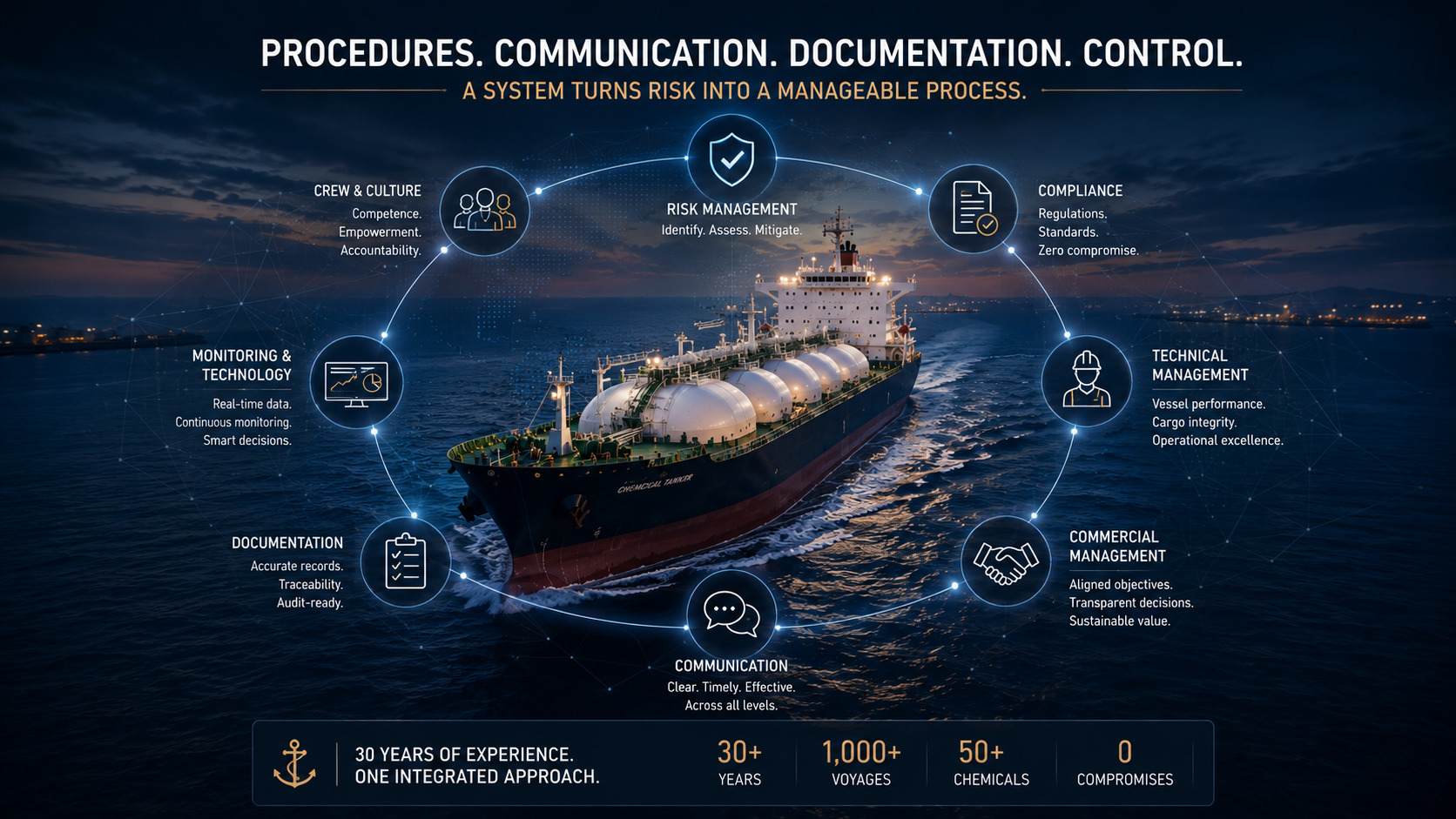
The main conclusion from 30 years of practice is simple. Complex cargo is not a matter of one person's courage or experience. It is a matter of the system: procedures, communication, documentation, and the integration of commercial and technical management. Where there is a system, a non-standard situation becomes manageable. Where there is no system, any voyage can be the last.
If you work with non-standard cargo - or are only considering entry into this segment - we recommend beginning with an audit of existing procedures and an honest answer to the question: do you have a system, or do you only have the experience of individual people? People leave. The system remains.
The Overhorn Swiss AG team addresses questions of this kind on a daily basis. We are ready for a substantive conversation - without generalities and checkbox presentations.
· · ·


