
 En
En  De
De


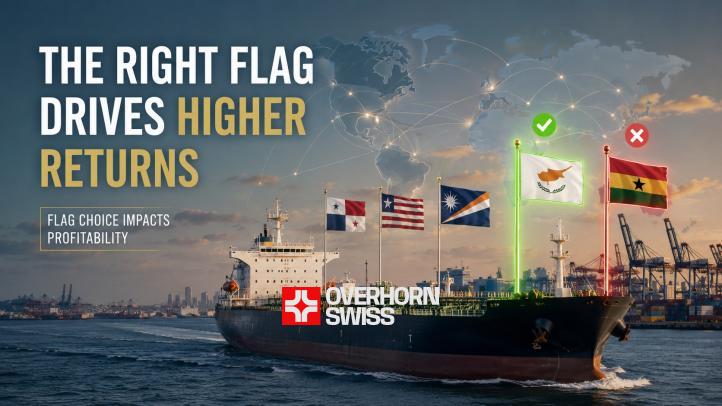
Most shipowners think about the flag last - after the vessel price, freight, and insurance. That is precisely the mistake that quietly erodes returns year after year.
Consider this: an investor acquires a product tanker, carefully calculates OPEX, TCE, and breakeven, agrees terms with a manager, and insures the vessel. Everything adds up. Eight months later it emerges that the chosen flag appears on the Paris MOU grey list. The first PSC inspection in Rotterdam ends in a four-day detention. A major oil trader declines a time charter - the vessel fails vetting. The insurer revises the H&M premium upward. The year-end result: minus 12-15% against the projected return.
How is this possible when everything was calculated? Very simply: the flag was not calculated. It was treated as a formality. And formalities in shipping are the most expensive things of all.
The flag is not a sticker on the stern. It is a business decision that affects every line of your P&L.
What Is a Flag State and Why It Is Not Simply a "Paper Matter"
A flag state is the jurisdiction under whose legislation a vessel operates. The flag determines who the regulator is, what requirements are imposed on the crew, how the tax burden is calculated, and what the vessel's legal status is in international waters.
Three key functions of a flag that directly affect the vessel's economics:
- Administrative - registration, surveys, issuance of certificates, supervision of compliance with IMO conventions.
- Fiscal - tax regime, tonnage tax, registration and annual fees.
- Operational - crew composition requirements, vetting acceptability with charterers, standing in Port State Control rankings.
Most shipowners have a good understanding of the first two functions. The operational one is almost always underestimated. Yet it is precisely the one that generates the hidden losses invisible at the time of purchase.
Every shipowner selects a flag in their own way. But unlike choosing a flagpole for the office, the cost of a mistake here is measured not in awkwardness but in real money over the entire period of ownership.
The World Registry Map: Open, Closed, and Second Registers
Before calculating costs, one needs to understand the architecture of the choice. There are currently three fundamentally different types of registry.
Open Registries (Flags of Convenience)
Panama, Marshall Islands, Liberia, the Bahamas, Cyprus - the world's largest open registries. A shipowner is not required to have any economic ties to the flag state. The appeal is obvious: low fees, flexible crew requirements, fast registration.
However, "open" does not mean "equivalent." The Marshall Islands and Liberia are premium open registries with high PSC standing and an excellent vetting reputation. Several other open registries consistently appear on MOU grey or black lists. Panama is not only about the canal and hats. It is the world's largest registry with enormous internal variability in the quality of administration - something a broker selling a vessel will most often fail to mention.
Closed and National Registries
Germany, Greece, Norway, the United Kingdom - registries accessible primarily to residents or companies with genuine economic ties to the country. As a rule, they impose higher crew requirements and greater administrative burden, but their tax regimes are often better structured for long-term ownership.
Second Register - a Hybrid Model
NIS (Norway), MAR (Madeira/Portugal), DIS (Denmark) - a compromise between the flexibility of an open registry and the reputation of a national one. These allow the engagement of an international crew while retaining access to local tax regimes.
Comparative Table of Key Registries
| Registry | Type | PSC Status | Manning | Tonnage Tax | Registration | Vetting |
|---|---|---|---|---|---|---|
| Marshall Islands | Open | White list | Free | Yes | 24-48 h | High |
| Liberia | Open | White list | Free | Yes | 24-48 h | High |
| Panama | Open | White / grey* | Free | Yes | 24-72 h | Medium |
| Bahamas | Open | White list | Free | Yes | 48-72 h | High |
| Cyprus | Open / EU | White list | Flexible | Yes (EU) | 2-5 days | High |
| Malta | Open / EU | White list | Flexible | Yes (EU) | 2-5 days | High |
| NIS (Norway) | Second register | White list | International | Yes | 3-7 days | Very high |
| Cheap open registries** | Open | Grey / black | Free | Partial | Fast | Low |
* Depends on sub-registry and administrator. ** Certain registries in Africa, Asia, and the Caribbean.
Five Hidden Costs of a "Cheap" Flag
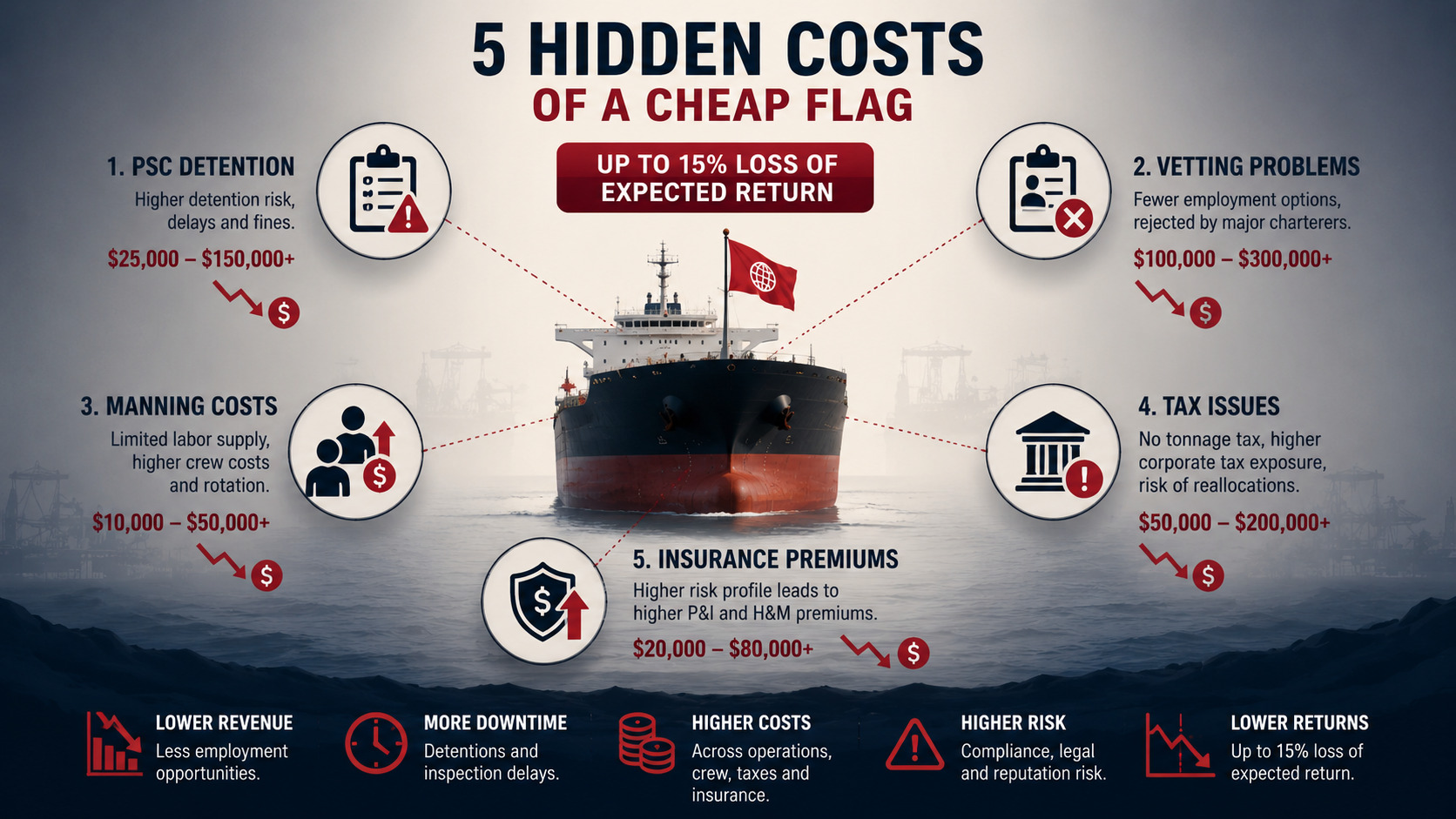
This is the central question. This is where those 15% mentioned in the headline actually live. Let us examine each category of loss separately - with figures, not abstractions.
PSC Detentions and Their Real Cost
Port State Control is a system for inspecting vessels in foreign ports. Each flag receives a rating based on its accumulated detention statistics. Under the Paris MOU, Tokyo MOU, and other regional memoranda, flags are divided into white, grey, and black lists.
Practical consequences for the owner of a vessel flying a "grey" flag:
- Increased inspection frequency - instead of once a year, effectively at every port call.
- A stricter approach by inspectors - a "presumption of guilt" built into the very psychology of the inspection.
- A higher probability of detention even when the vessel is in technically acceptable condition.
Calculating the losses. One day of detention for a VLCC in port represents $55,000-80,000 in lost revenue. A medium-sized product tanker (MR) - $18,000-30,000 per day. Four days of detention per year already amounts to $80,000-120,000 in direct losses. Add penalty clauses under the charter party, plus reputational damage with the charterer.
Remember the key point: the cheapness of a registration fee at $5,000-8,000 per year never compensates for a single detention. Never.
Vetting and Access to the Charter Market
SIRE 2.0 (Ship Inspection Report Programme) is the inspection system used by the world's largest oil majors and traders: Shell, BP, TotalEnergies, Vitol, Trafigura. CDI (Chemical Distribution Institute) fulfils the same function for chemical tankers. A vessel's flag is one of the factors that directly influences the decision on charter acceptance.
What happens when a flag raises questions with a charterer:
- The vessel is placed in the "requires additional review" category - inspections at your cost and with your delays.
- Some major charterers place flags on a "restricted list" - meaning the vessel is simply not considered, regardless of its technical condition.
- The available pool of charterers narrows - competition for the remaining ones intensifies, and rates fall.
The result is a reduction in TCE of 8-12% compared to an equivalent vessel under a reputable flag - simply because there are fewer buyers for your freight.
Crew Costs and Manning Requirements
Some registries - primarily national ones and a number of European registries - require a certain percentage of the flag state's nationals to be kept on board. This directly affects OPEX: the cost of a European seafarer is three to five times higher than that of a seafarer from the Philippines, Ukraine, or India.
Comparing two scenarios for an MR tanker (Medium Range, ~50,000 DWT):
| Cost Item | Flag with Manning Restrictions | Flag with Free Manning | Annual Difference |
|---|---|---|---|
| Captain + chief officer (EU) | $280,000 | $90,000 | +$190,000 |
| Remaining crew | $320,000 | $280,000 | +$40,000 |
| Total (crew OPEX) | $600,000 | $370,000 | +$230,000 |
$230,000 per year in additional crew costs alone. For a vessel worth $35-40 million, that is a tangible drag on investor returns.
Tax Regime and Tonnage Tax
Tonnage tax is a special tax regime under which tax is calculated based on the vessel's tonnage rather than actual profit. In profitable years for the freight market, the difference compared to corporate tax can be very significant.
The principal tonnage tax jurisdictions:
- Greece - one of the most well-developed regimes, historically favourable for shipping companies.
- Cyprus and Malta - EU jurisdictions with recognised tonnage tax regimes, suitable for international structures.
- Norway - Norwegian Tonnage Tax with an effective rate close to zero when conditions are met.
- Netherlands, United Kingdom - mature regimes with additional options for shipping groups.
A hidden risk that is rarely discussed: a number of jurisdictions have no active double taxation agreements (DTAs) with the key countries of residence of the beneficial owners. As a result, the owner pays in both the flag state and at home. Choosing a flag without analysing the DTA matrix is like buying insurance and not reading the exclusions section.
Insurance: P&I and H&M
A vessel's flag is one of the underwriting factors for P&I (Protection & Indemnity) clubs and Hull & Machinery insurers. The logic is straightforward: flags with poor PSC statistics are statistically correlated with accidents, detentions, and claims. Insurers know this very well and price it into the rate.
Practical consequences:
- Additional loading on H&M premium: +5-15% on the base rate for "problematic" flags.
- P&I clubs may impose additional conditions or a surcharge based on flag.
- Following a PSC detention, the insurer may revise terms at the next renewal.
The cumulative effect over five years of owning an MR tanker - an additional $150,000-300,000 in insurance costs alone. And that excludes potential losses from the incidents themselves.
When an "Expensive" Flag Turns Out to Be Cheaper
The Marshall Islands charges around $15,000-20,000 per year to register an MR tanker. A cheap Caribbean registry will offer $4,000-6,000. The difference is $10,000-14,000. It seems like an obvious choice. Now let us look at the full picture.
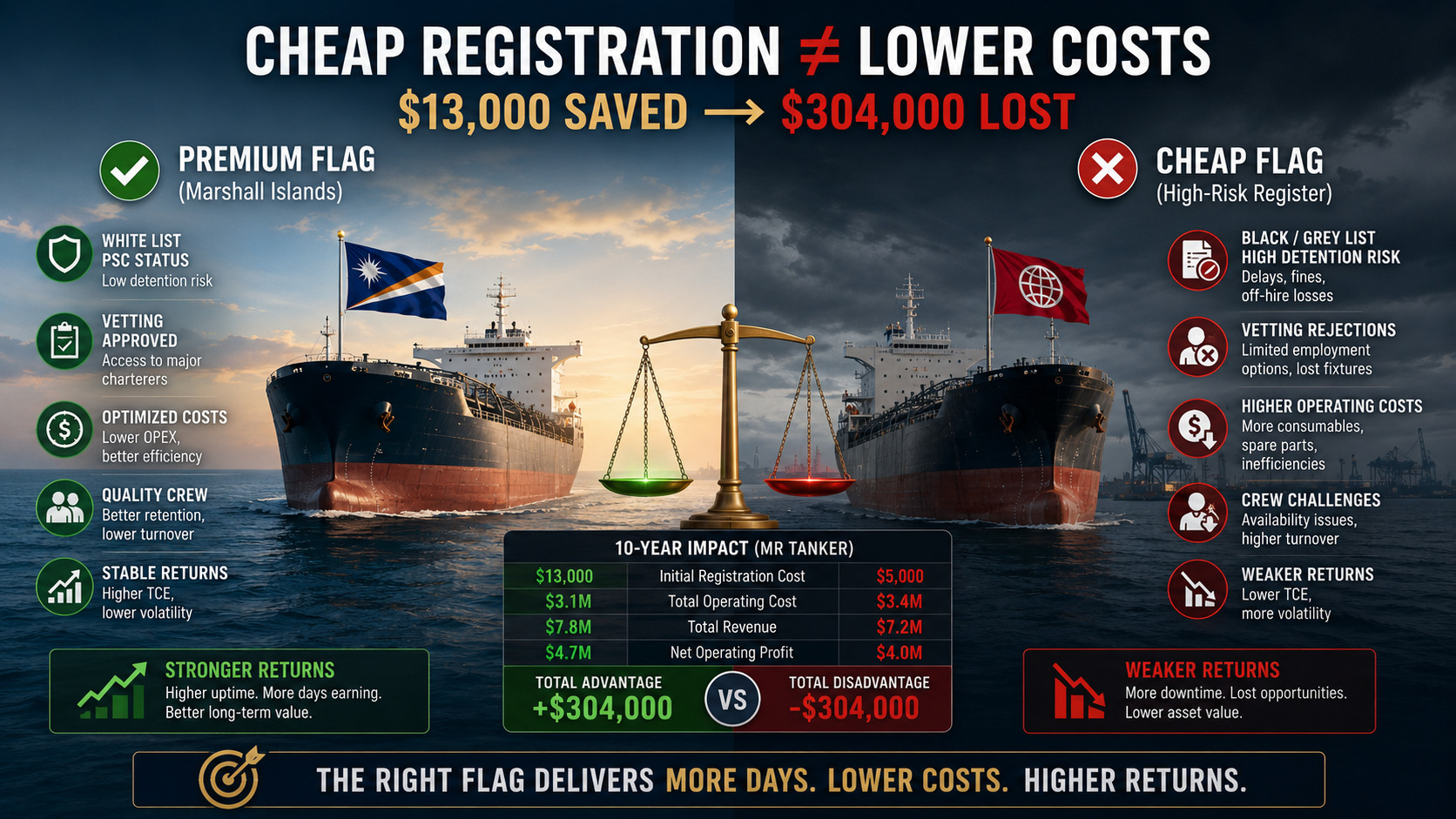
| Cost Item | Premium Open Registry | Cheap Registry | Annual Difference |
|---|---|---|---|
| Registration fees | $18,000 | $5,000 | -$13,000 |
| Additional PSC inspections | $0 | $12,000 | +$12,000 |
| Losses from detentions (average) | $15,000 | $95,000 | +$80,000 |
| TCE reduction due to vetting | $0 | $180,000 | +$180,000 |
| Insurance surcharge (H&M + P&I) | $0 | $45,000 | +$45,000 |
| Total hidden losses | $33,000 | $337,000 | +$304,000 |
The "saving" of $13,000 on registration translates into an additional $304,000 in losses. That is precisely the 12-15% of returns on an asset worth $35-40 million.
It is like buying cheap thermal underwear: the inexpensive option keeps you warm for the first two weeks. Then you start feeling cold and counting the losses. Only in shipping, the losses are somewhat larger in scale.
How to Choose the Right Flag for a Specific Strategy
There is no universal answer. The right flag is one that precisely matches your strategy - not your neighbour's and not the one that was relevant five years ago. Five factors will help you decide.
Asset Type
For crude oil tankers and product tankers, SIRE vetting is critical - a flag's reputation directly affects access to the charter market. For chemical tankers, CDI is added. Bulk carriers and container ships have a different vetting culture, but PSC statistics remain important.
Trade Geography
Which MOU zones will the vessel transit? Europe and the US - Paris MOU and USCG. Asian trade - Tokyo MOU. It is important to understand in advance which PSC regimes will be inspecting the vessel, and to choose a flag with a good reputation specifically in those zones.
Ownership Structure
Where is the SPV registered? Is there a DTA between the flag state and the beneficial owner's country of residence? Is bank financing planned - many banks maintain their own "approved flag" lists? These questions are resolved before signing the MOA, not after.
Ownership Horizon and Exit Strategy
A flag for a short-term asset play with a sale in 2-3 years and a flag for long-term ownership have different priorities. Upon sale, the flag affects the pool of potential buyers and the asset's valuation: a vessel under a "clean" flag with a good PSC history commands a higher price on the secondary S&P market.
Manning Policy
In-house Manning Department or a third-party Ship Manager? If management is being delegated to a professional manager, it is worth establishing which registries they work with effectively. A good manager always has established relationships with specific flag administrations, and that genuinely accelerates the resolution of operational issues.
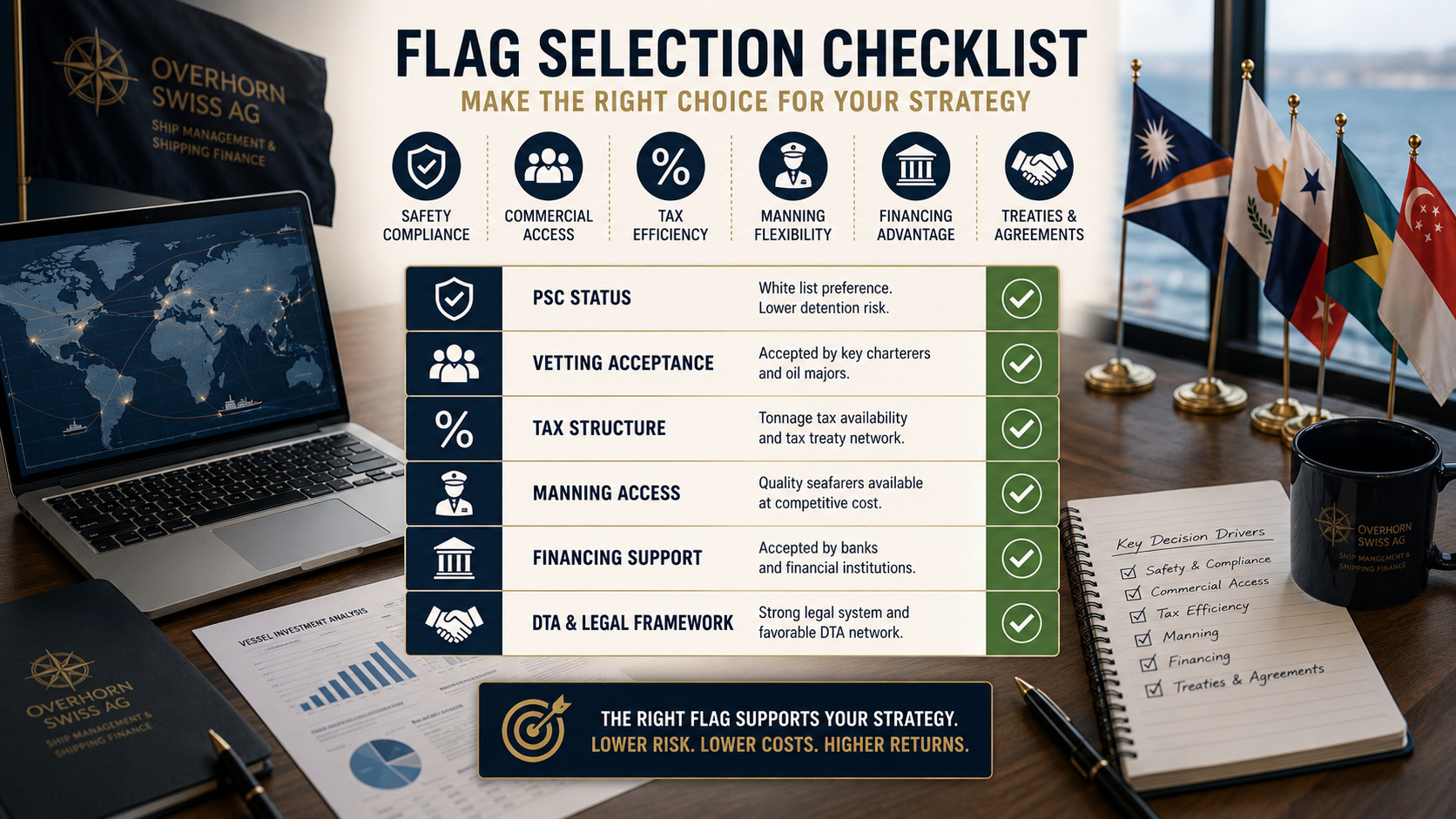
Flag Selection Checklist
- Is the flag on the white list of Paris MOU and/or Tokyo MOU?
- Is the flag accepted by major charterers without additional vetting restrictions?
- Is there a tonnage tax regime, and does it suit the ownership structure?
- Is there a DTA in force between the flag state and the beneficial owner's jurisdiction?
- Is the flag compatible with the financing bank's requirements?
- What are the actual manning requirements - are there national crew restrictions?
- How does the flag administration handle urgent certification matters?
- What is the flag's reputation on the secondary S&P market among buyers?
The Role of a Professional Adviser in Flag Selection
At this point, there is a temptation to delegate the decision to a broker or a corporate lawyer. Both will provide useful information - but partial information. A broker knows the market and deals, but rarely has a deep grasp of the tax nuances of tonnage tax. A lawyer structures the SPV but may not be familiar with the vetting realities of SIRE 2.0. A technical superintendent will assess the vessel's condition but will say nothing about the DTA matrix.
Flag selection is a decision sitting at the intersection of four disciplines simultaneously:
- Commercial - how the flag affects access to the charter market and TCE levels.
- Technical - PSC statistics, vetting compatibility, class requirements.
- Financial - tax regime, ownership structure, bank requirements.
- Legal - DTA, sanctions compliance, compatibility with the beneficial owner's jurisdiction.
Within Overhorn Swiss AG's turnkey S&P model, flag analysis is a mandatory element of due diligence at the asset evaluation stage - before the client has made an investment decision. It is not a separate service and not an additional line in the project budget. It is part of a disciplined process that allows the full picture of the cost of ownership to be seen before the Memorandum of Agreement is signed.
This is precisely why we recommend treating flag selection not as an administrative matter but as a strategic one - with the same seriousness applied to evaluating the asset itself.
A Flag That Works for You
Let us return to the investor from the beginning of this article. What would have happened if flag analysis had been part of due diligence before the transaction? He would have seen the PSC status of the registry. He would have checked vetting acceptability with the target charterers. He would have compared the total costs, not just the registration fee. And he would probably have chosen a different flag - more expensive by $12,000 per year, but cheaper by $300,000.
If you already have a fleet, ask yourself three questions right now:
- On which Paris MOU and Tokyo MOU list does your flag currently appear?
- Do all your target charterers accept this flag without restrictions?
- When did you last compare the total cost of ownership under your current flag against the alternatives?
If you cannot answer even one of these questions with confidence - that is a signal. Not a cause for alarm, but a reason for a conversation with a specialist.
The right flag does not draw attention to itself. It simply works quietly for your returns. Year after year.
Overhorn Swiss AG
info@overhorn.ch · +41 79 828 07 07
Ship Management & Shipping Finance
Strategic Maritime Transactions, Seamlessly Executed


