
 En
En  De
De


Imagine two shipowners. Both have an Aframax built in 2017. Same route, same bunker, same crew size. But at the end of the quarter, one earns a TCE $1,800 above the daily rate. The other goes to arbitration - to contest a speed & consumption claim from the charterer. And loses. Because he has no data. None whatsoever.
This is not a hypothetical situation. This is exactly what the market looks like today - where some are already managing their fleets through data, while others still regard digital monitoring as an "interesting technology for the future."
The question has long since ceased to be whether digital monitoring should be implemented. The question is: at what point does a fleet manager who fails to use it begin to breach his professional duty to the asset owner?
That is precisely what this article is about.
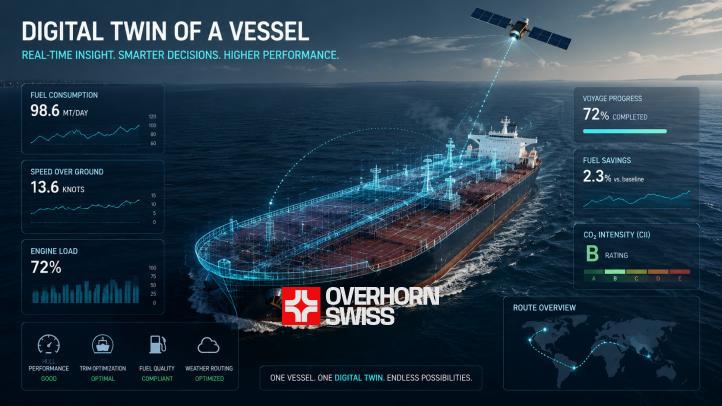
What a vessel's digital twin actually is
The term "digital twin" misleads many people from the outset. The word "twin" conjures up images of a sleek three-dimensional render of a vessel on a screen - something from a presentation at Nor-Shipping. In practice, however, that has almost nothing to do with it.
A vessel's digital twin is a live virtual model that reflects, in real time, the physical condition and behavior of a specific ship. Not a generic Aframax from a database - but yours, with its hull history, main engine characteristics, and accumulated consumption profile.
The model draws on data from multiple sources simultaneously:
- Main engine and auxiliary equipment readings
- Speed, draft, and trim data
- Hull condition (hull performance index)
- Meteorological and hydrographic data along the route
- Bunker consumption and quality data
The industry recognizes three levels of digital twin maturity:
| Level | Model Type | What It Provides | Example Application |
|---|---|---|---|
| 1 | Descriptive | Shows what is happening now | Real-time fuel consumption monitoring |
| 2 | Predictive | Forecasts what will happen | Predictive main engine bearing wear |
| 3 | Prescriptive | Recommends a specific action | Optimal speed and trim for the current voyage |
Most companies today operate at level one or two. That is precisely why the gap between those who have already moved to prescriptive analytics and those who are only beginning to monitor will continue to widen.
Tankers, in fact, are the ideal segment for a digital twin. Long voyages generate a sufficient volume of data. High OPEX makes every percentage point of fuel savings meaningful. And stringent vetting requirements (SIRE 2.0, CDI) create an additional incentive for documented oversight.
The economics: what monitoring actually delivers
The most elegant platform is worth nothing if you don't count the money. So let's start with the numbers.
TCE optimization through speed and trim management
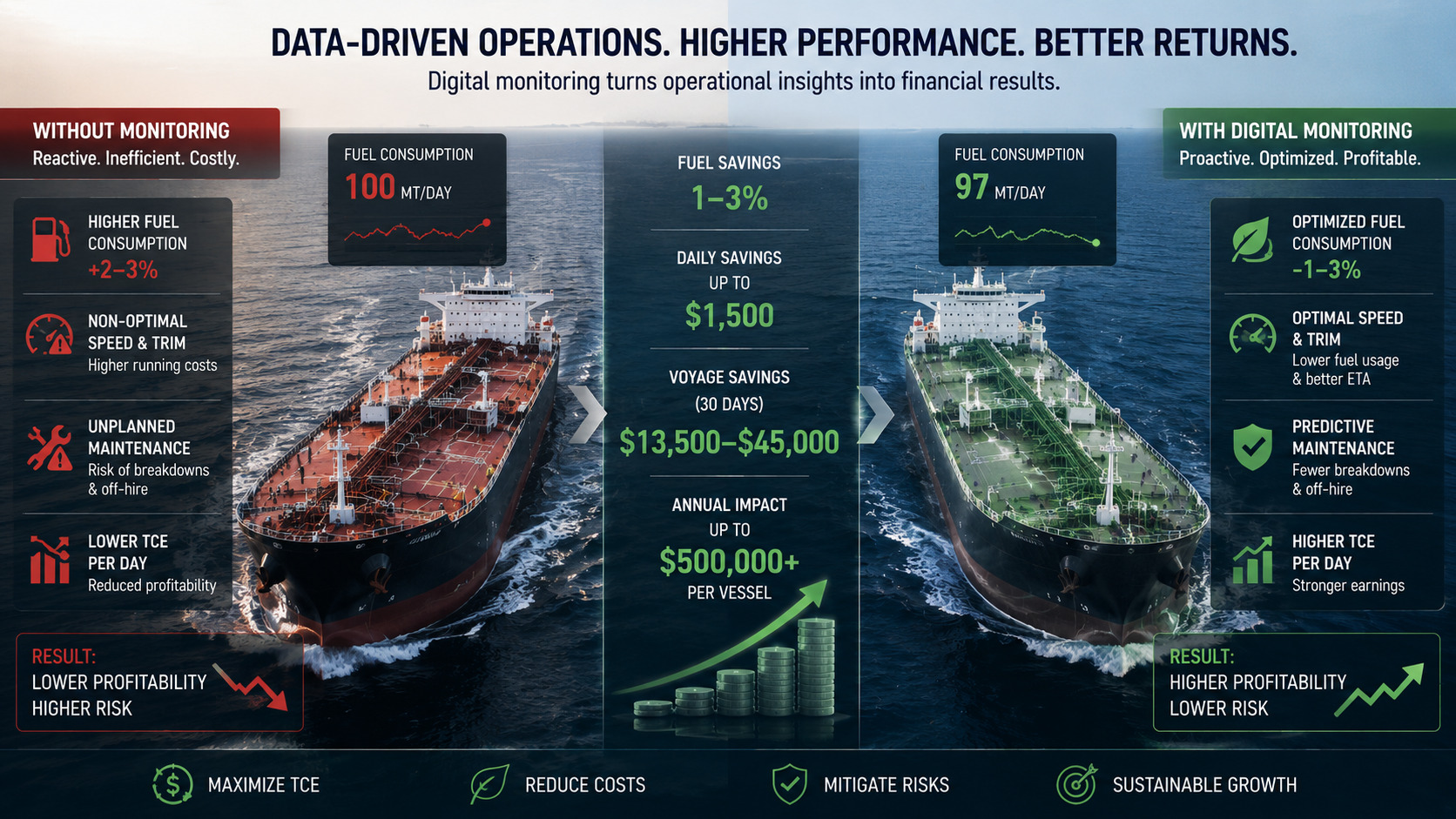
A fuel saving of 1-3% sounds modest. But on a VLCC consuming around 90-100 tonnes of IFO per day, it means:
- At a bunker price of $500/mt - a saving of $450-1,500 per day
- On a Persian Gulf - Rotterdam voyage (~30 days) - $13,500-45,000 per voyage
- Over a full year - up to $500,000+ per vessel
That is precisely why large operators have long stopped treating voyage optimisation as an option - for them it is basic operational discipline.
Hull performance: when drydocking is actually needed
One of the most costly management decisions in ship management is when to put a vessel into drydock. Premature CAPEX erodes profitability. An overdue drydock means rising fuel consumption from hull fouling and the risk of vetting observations.
The digital twin resolves this dilemma through the Hull Performance Index (HPI) - a continuously updated measure of the degradation of the hull's hydrodynamic characteristics. Instead of a rigid calendar-based docking schedule, the manager has objective data on which to base the decision.
CII and regulatory compliance
Since 2023, the Carbon Intensity Indicator (CII) has become a mandatory element of flag compliance. Vessels receive a rating from A to E. A D or E rating for three consecutive years triggers a corrective action plan and the risk of PSC detention.
Without a monitoring system, managing the CII rating is impossible. That is not an exaggeration - it is mathematics. CII is calculated on the basis of actual fuel consumption data and miles sailed, and without continuous tracking a manager simply does not know where a vessel stands on the scale until the annual report arrives.
Off-hire and demurrage: the cost of a reactive approach
| Approach | Logic | Typical Consequences |
|---|---|---|
| Reactive (no monitoring) | Repair after failure | 3-7 days off-hire, freight loss, demurrage, reputational damage |
| Predictive (with monitoring) | Component replacement at a scheduled port call | 0-8 hours of planned downtime, zero demurrage |
This is not technology for technology's sake. It is a financial instrument with a measurable return.
From option to norm: how the market has changed
Five years ago, having a performance monitoring system was a competitive advantage. Today, it is a question your manager will face at the very first vetting interview.
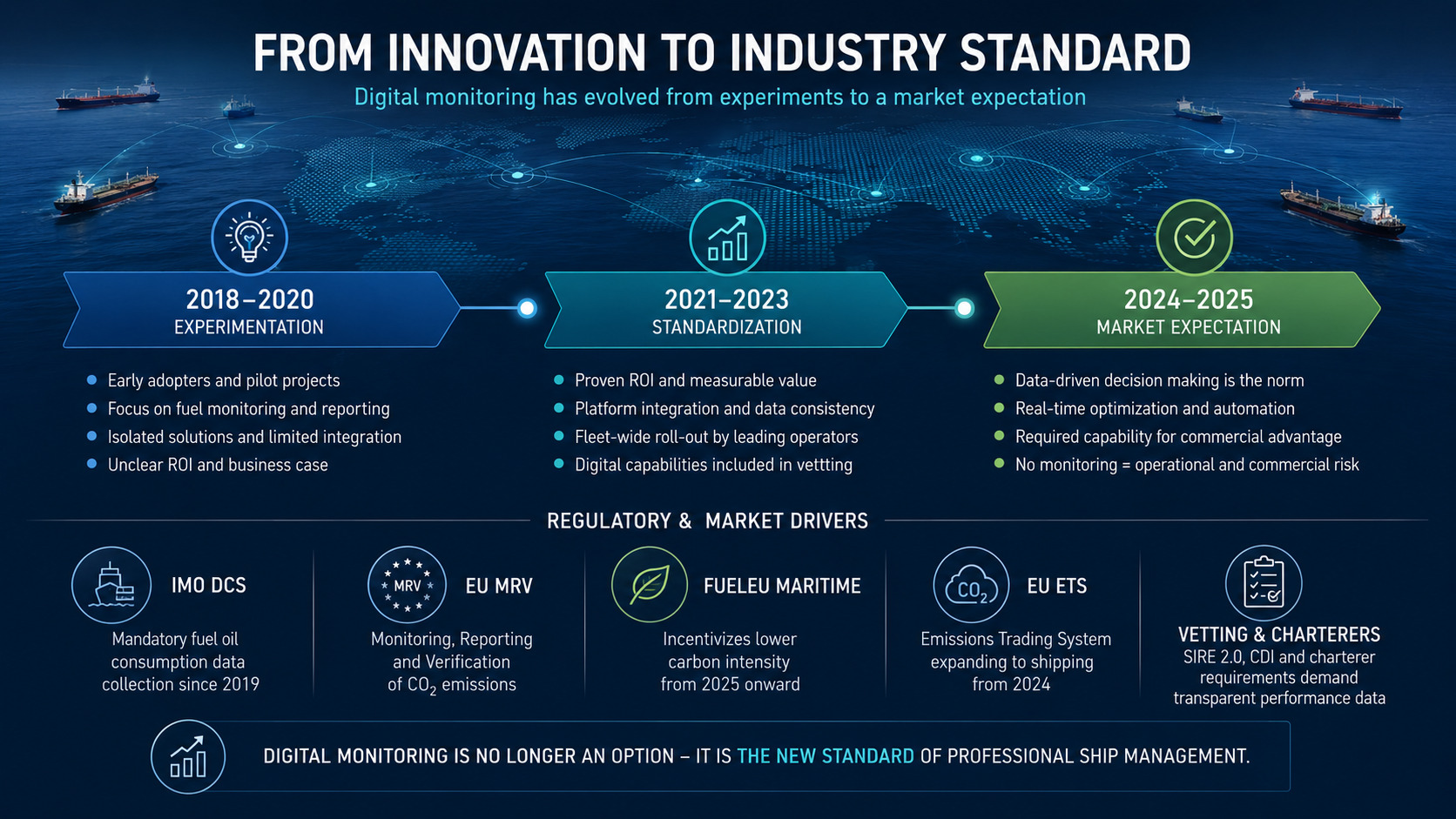
The market has gone through three clearly distinct phases:
- 2018-2020 - Experimental phase. First pilot projects among large operators. Platforms were raw, data unreliable, and skepticism high.
- 2021-2023 - Standardization phase. IMO DCS and EU MRV created a regulatory framework. Major chartering players began including monitoring requirements in charter parties. Insurers began asking questions.
- 2024-2025 - Market expectation phase. The absence of a monitoring system starts to affect commercial negotiations. Some major traders prefer tonnage with verified performance data.
Major oil majors - Shell, BP, TotalEnergies - updated their vetting criteria some time ago. Today those criteria include questions about performance monitoring tools, data management systems, and deviation verification procedures. This is not a formality - it is part of risk assessment.
The regulatory framework is adding to the pressure:
- IMO DCS - mandatory fuel consumption data collection since 2019
- EU MRV - reporting verification for vessels calling at EU ports
- FuelEU Maritime - from 2025: greenhouse gas emission intensity requirements
- EU ETS - from 2024: maritime transport included in the European emissions trading system
Insurers and P&I clubs are a separate story. When settling hull and machinery claims, they are increasingly requesting monitoring data histories. The absence of such a history is not a neutral fact. It is a signal about the quality of management.
Fiduciary duty: where choice ends
Can you say to an investor or shipowner today: "we do not monitor vessel performance in real time"? Formally, yes. But with each passing year, that statement sounds increasingly unprofessional.
Fiduciary duty in the context of ship management means that the management company is obliged to act in the best interests of the asset owner - with the same degree of care that a reasonable professional would apply to managing their own property.
This duty has three dimensions:
To the shipowner
A vessel worth $50-150 million is not simply an operational asset. It is an investment with a specific required return. Managing such an asset without continuous monitoring of its technical and commercial performance is roughly analogous to managing an investment portfolio without access to market data. No one would call that professional management.
To the charterer
In time charter parties, performance warranties are binding conditions. Guaranteed speed and fuel consumption are set out in the contract. If a deviation occurs, the charterer raises a claim. And here is where it really matters: without monitoring data, the manager can neither dispute the claim nor demonstrate that the deviation was caused by weather conditions rather than the vessel's technical condition.
LMAA (London Maritime Arbitrators Association) arbitration practice has accumulated a body of decisions in which the absence of verified performance data resulted in a loss - even when the facts of the case were on the shipowner's side. A tribunal operates on evidence, not recollections.
To the regulator
CII, EU MRV, EU ETS - all of these require documented compliance. Not declared - documented. The distinction is fundamental: a declaration can be challenged; verified monitoring data is considerably harder to contest.
The conclusion is uncomfortable but direct: ignorance of a fleet's own condition is no longer a neutral stance. In the context of today's market and regulatory requirements, it amounts to negligence.
How it works in practice: from data to decision
Data on its own is just noise. What matters is what you do with it.
A typical monitoring system architecture looks as follows:
- On-board data collection - sensors integrated with the vessel's SCADA system capture engine readings, fuel consumption, speed, and navigation data
- Data transmission - a satellite link (VSAT or Iridium) delivers data ashore at defined intervals (typically every 15-60 minutes)
- Cloud processing - the platform normalizes the data and applies weather and load correction models
- Analytics layer - deviations, alerts, recommendations, reporting
- Decision-making - the commercial and technical manager see the same data, but through different lenses
Key platforms present in the market:
| Platform | Developer | Key Strength |
|---|---|---|
| Vessel Insight | Kongsberg | Deep integration with on-board equipment |
| Voyage | Wärtsilä | Route and speed optimization |
| Veracity | DNV | Data verification, integration with classification |
| ABB Ability | ABB Marine | Energy efficiency management |
It is important to understand that the commercial manager and the technical manager look at the same data in very different ways:
- The technical manager sees a fuel consumption deviation as a signal about engine condition or hull fouling
- The commercial manager sees the same deviation as a risk of breaching a performance warranty and a potential claim
- The shipowner sees it as a change in projected TCE and an impact on asset profitability
That is precisely why an integrated approach - where commercial and technical management work on a single platform - is many times more effective than fragmented systems.
And here it must be said plainly: a platform without a qualified analyst is an expensive screen. We have seen cases where companies spent considerable sums on subscriptions, yet data interpretation remained at the level of "we look at it if something is obviously broken." That is not monitoring. That is an expensive event log.
Overhorn Swiss AG: commercial management in the age of data
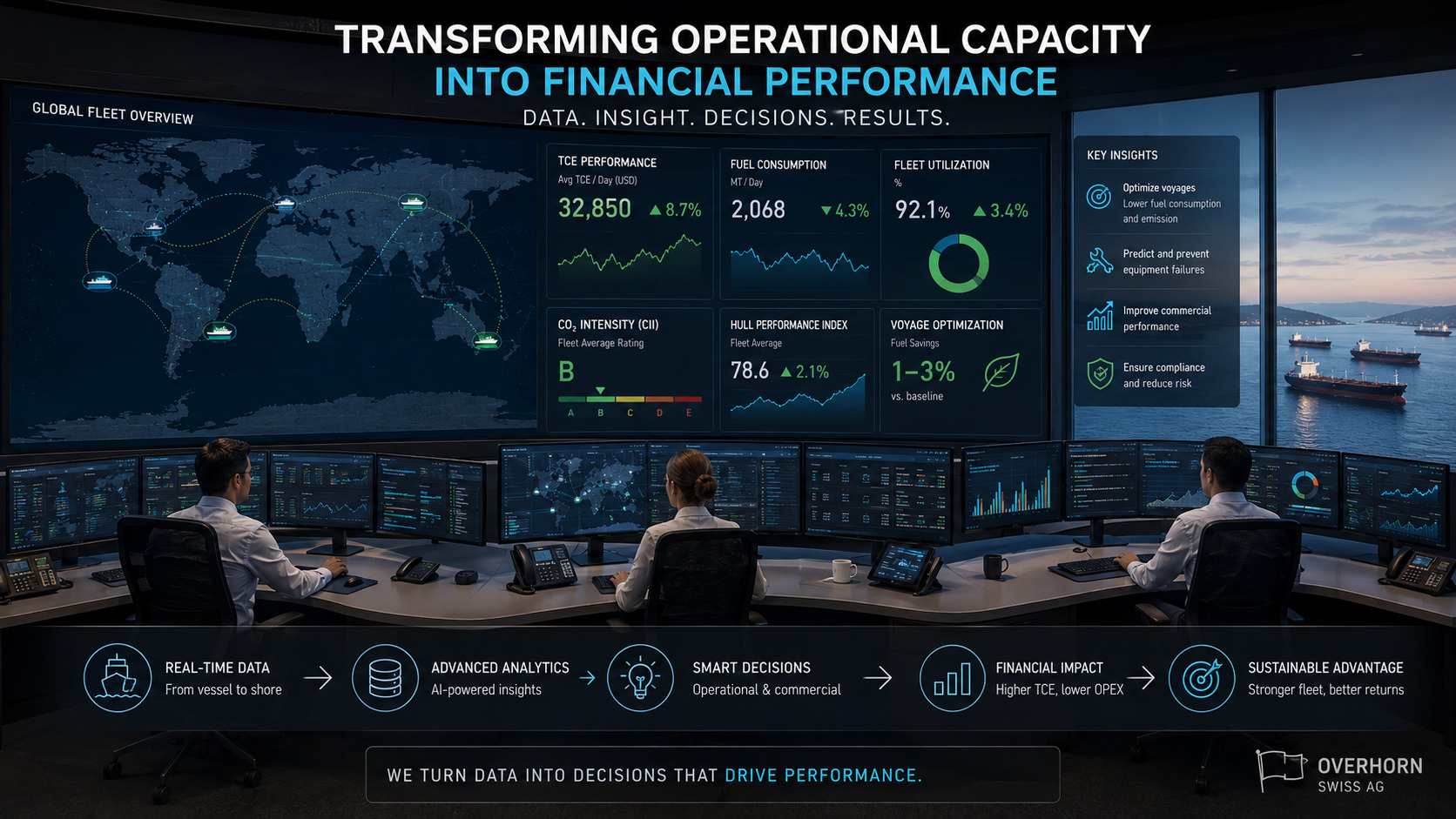
That is precisely why the integration of commercial and technical management is not an option, but an architecture of how the work is done.
The philosophy of Overhorn Swiss AG is built on the premise that every vessel is a financial asset, not merely an operational unit. "Transforming operational capacity into financial performance" is not a marketing phrase. It describes how a data-driven approach reshapes each of the five pillars of commercial management.
Chartering & Employment
A vessel's market positioning changes fundamentally when the manager has verified data on its actual performance. It becomes possible to know precisely on which route and at which speed the vessel delivers the maximum TCE - and to fix a charter specifically against those parameters, rather than against generic market benchmarks.
Voyage Planning
TCE optimization through monitoring is not the intuition of an experienced master. It is a calculation of optimal trim, speed, and route based on up-to-date data on hull condition, weather forecasts, and bunker prices at ports of call. The difference between "sailing faster" and "sailing optimally" can amount to hundreds of thousands of dollars over the course of a year.
Freight Market Analysis
Monitoring market indices (Baltic Dirty Tanker Index, Worldscale) in correlation with actual fleet performance data enables commercial decisions to be made with considerably greater precision - for instance, identifying the optimal moment to move from spot to time charter, taking into account the vessel's real technical condition.
Performance Reporting
Transparent P&L is a consequence of digital oversight, not an independent objective. When every voyage is documented in terms of consumption, speed, and deviations from benchmark, reporting to the shipowner becomes not a procedure, but an instrument of trust.
Claims & Post-Fixture Support
This is perhaps the most clear-cut example of the practical value of monitoring. In a demurrage dispute or a speed & consumption claim, the data from the monitoring platform becomes the evidentiary basis. A verified voyage history is an argument that is difficult to challenge.
Swiss business culture stands for precision, transparency, and long-term thinking. It is within this environment that data-driven ship management feels not like an innovation, but like the only sensible way to operate.
Barriers: an honest conversation
It would be dishonest not to address what genuinely stands in the way of implementation. Every solution has its drawbacks.
Implementation cost
Equipment for a single vessel (sensors, VSAT upgrade if required, integration with existing systems) ranges from $30,000 to $80,000 as a one-off investment. An annual platform subscription runs $15,000-40,000 depending on functionality. For a small fleet of 3-5 vessels, these are significant investments.
Data quality
The "garbage in, garbage out" principle applies in full force in vessel monitoring. Poorly calibrated flow meters, inaccurate data from the ship's log, transmission failures - all of this creates noise that complicates decision-making. That is precisely why data quality is an operational discipline, not a technical problem.
Connectivity
In certain regions (Arctic routes, parts of the Pacific Ocean) satellite coverage remains unreliable or expensive. This is a genuine constraint, though one that is gradually diminishing as Low Earth Orbit satellite constellations develop (Starlink Maritime is already operational on many tankers).
The human factor
This is perhaps the most underestimated barrier. Masters and chief engineers with years of experience often perceive monitoring systems as instruments of control rather than support. Overcoming this resistance is a management task, not one for the IT department.
Nevertheless, for all the reality of these barriers, the conclusion remains unchanged: the cost of inaction exceeds the cost of implementation. And that gap grows wider with every passing year.
The final argument
Let us return to the two shipowners from the opening of this article. The one with monitoring data won the arbitration - the speed & consumption claim was dismissed because the platform logs clearly showed that the deviation from guaranteed performance was attributable to weather conditions, not the vessel's technical condition. Moreover, at the next charter negotiations, he was able to substantiate the vessel's actual performance with verified data - and fixed the rate at $1,900/day above market.
The second shipowner paid the claim, lost 5 days of off-hire to an unplanned repair, and entered the next negotiations with the master's handwritten notices as his only argument.
Digital monitoring is not a technology. It is a standard of managerial accountability. In a world where CII affects a vessel's commercial attractiveness, EU ETS adds to operational costs, and charter parties contain performance warranties - managing a fleet without data means managing blind.
The question is no longer "to implement or not." The question is "with whom."
That is precisely why at Overhorn Swiss AG we build commercial fleet management as an integrated system where vessel performance data is not an appendix to a report, but the foundation of every commercial decision - from route selection to negotiations on the next fixture.
If you would like to discuss how this applies to your fleet, we are ready to talk.


