
 En
En  De
De


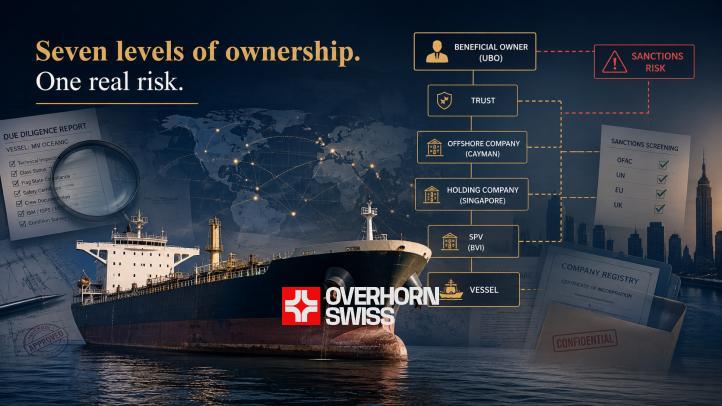
Most vessel buyers are confident: they conducted a technical survey, received a solid surveyor's report - the deal is clean. This misconception has cost many investors asset freezes, sanctions investigations, and reputational damage that no one likes to discuss openly.
Here is a typical scenario. The deal is closed, the vessel has been accepted, the funds have been transferred. Three months later, the legal department of the financing bank discovers that the beneficial owner of the seller's chain is a party listed on an updated OFAC SDN list. The asset is frozen. The proceedings will drag on for years. And all of this - with a perfectly functioning main engine and a fresh class certificate.
The vessel is not the issue here. The risk has always been in the people behind it. In shipping, the gap between "who owns" and "who is registered as the owner" is often a chasm filled with offshore jurisdictions, nominee directors, and cross-holdings.
In this article we will walk through all seven levels that must be verified as part of a comprehensive due diligence process in any S&P transaction - not as a theoretical framework, but as a practical working tool.
Why Shipping is Particularly Vulnerable
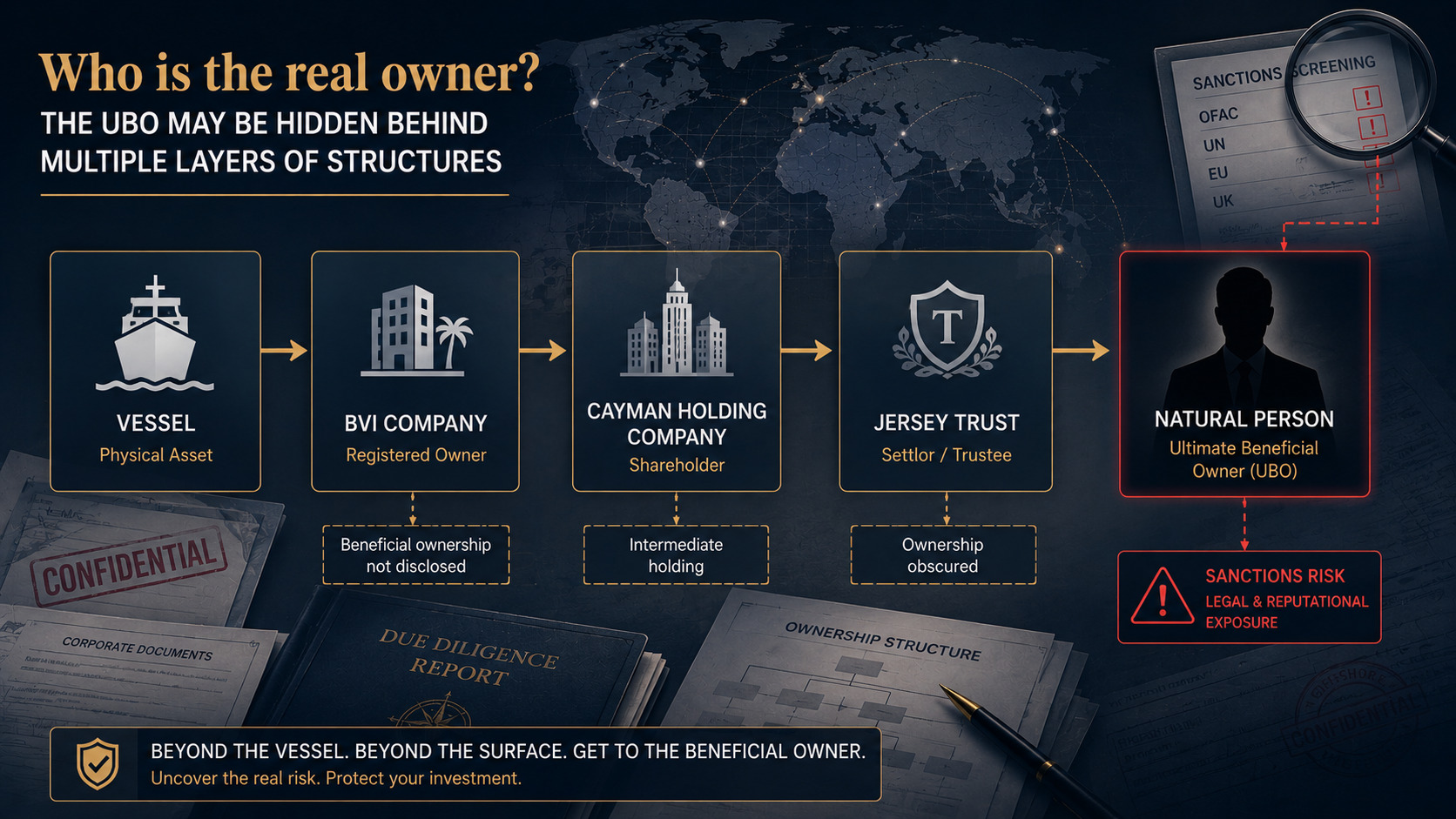
An offshore structure in shipping is not an exception, nor is it a sign of anything suspicious. It is standard industry practice. The vast majority of vessels are registered through an SPV (Special Purpose Vehicle) - a separate legal entity created for a single asset. Behind the SPV is a holding company. Behind the holding company - a trust or family foundation. Behind the trust - an individual who may be a resident of a sanctioned country.
Each layer of this structure adds opacity. And each layer is entirely legal in itself. The problem is not the structure - it is that no one looks at it deeply enough.
Buying a vessel without verifying its ownership structure is roughly like buying an apartment without ordering a registry extract. The asset may be in perfect condition. But it may carry an arrest.
Additional vulnerability factors:
- Flag of convenience - a vessel flying the flag of the Marshall Islands or Panama may be owned by anyone, anywhere in the world. The registry does not disclose the real owner.
- Frequency of sanctions list updates - OFAC, the EU, and the UK update their lists faster than deals are closed. A party that was clean at the time of signing the MoA may appear on the SDN list by the delivery date.
- AIS manipulation - some vessels deliberately disable their transponders on certain routes. The history of dark voyages is not visible in a standard technical report.
- Mixed jurisdictions - manager in Greece, owner in BVI, financing through Hong Kong, flag of Liberia. A compliance check requires working across multiple legal systems simultaneously.
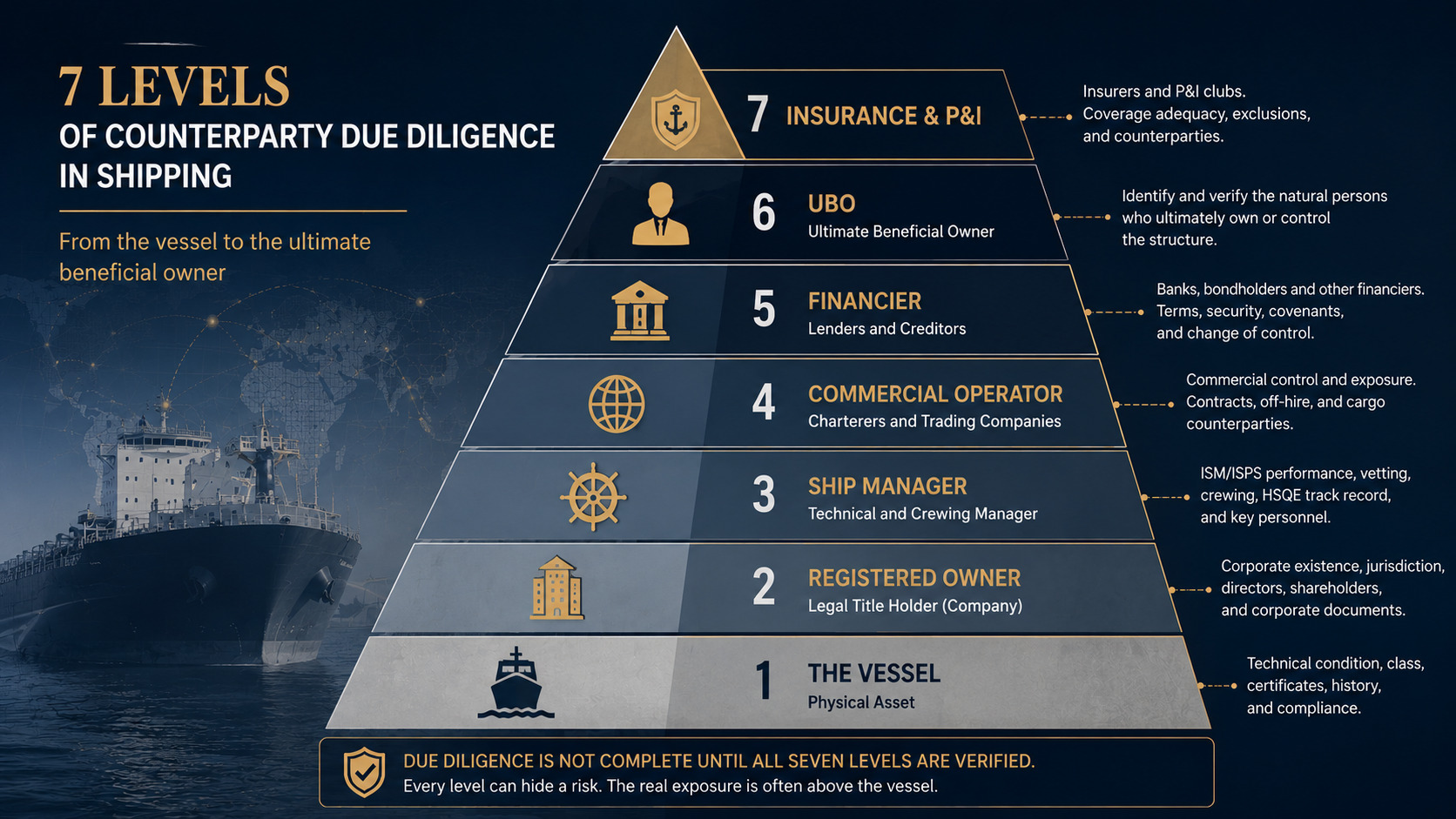
Level One: The Vessel Itself
Level 01 - Vessel
Let us start with the foundation - with what most buyers actually check. The physical asset, its condition, and its legal history. This level is mandatory, but not sufficient. Even a perfectly verified vessel can turn out to be part of a problematic chain.
What we verify:
- IMO number and name history - frequent changes of name or flag over a short period are a red flag
- Liens & encumbrances - mortgages, arrests, unresolved claims for freight and crew wages
- Port State Control history - detentions, deficiencies, recurring violations (especially MARPOL and ISM)
- SIRE/CDI inspections for tankers - validation history, withdrawal of previous inspections, frequency of checks
- CII rating and EEXI status - compliance with current IMO 2023 requirements
- Class and certificates - absence of conditions, recommendations, and overdue surveys
This level is the "body" of the asset. But every body has an owner. And it is from this point that the real due diligence begins.
Level Two: The Registered Owner
Level 02 - Registered Owner
The registered owner is the legal entity recorded in the ship registry. This is almost always an SPV - a company created for a single vessel. Such a structure is normal in itself. It becomes a warning sign only under certain circumstances.
What we verify:
- Jurisdiction of incorporation - BVI, Cayman Islands, Marshall Islands, Panama - jurisdictions with minimal transparency
- Company incorporation date - an SPV created 2-4 weeks before the transaction requires explanation
- Share capital - nominal capital of $1 for an asset worth $20 million is standard practice, but important context
- Directors and shareholders - are they nominees or real persons? Do they overlap with other known structures of the seller?
- Alignment of flag and owner's jurisdiction - a discrepancy is not a problem in itself, but adds complexity to verification
Red flag: The registered owner is incorporated in a zero-transparency jurisdiction, was created shortly before the vessel came to market, and the director is a nominee agent with no operational history whatsoever. Such a configuration does not mean fraud - but it means digging deeper is necessary.
Level Three: The Ship Manager
Level 03 - Ship Manager
This level is one of the most underestimated. The ship manager is typically considered in the context of technical condition, but rarely in the context of compliance. And that is a mistake. The manager bears ISM responsibility and knows the actual state of affairs better than any surveyor.
What we verify:
- DOC (Document of Compliance) - current, without conditions, issued by a recognized classification organization
- PSC statistics across the entire managed fleet - a single manager with a consistently poor PSC record is a systemic problem, not a coincidence
- Industry reputation - public incidents, previous DOC withdrawal, connections to sanctioned entities
- Crewing policy - crew nationality, ITF-compliance under the flag states, history of wage delays
Red flag: A change of ship manager within 3-6 months prior to the vessel being put up for sale. This is a classic attempt to "reset" the asset's history before the S&P transaction. We always request the management history for the preceding five years.
Level Four: The Commercial Operator
Level 04 - Commercial Operator
A vessel may be legally and technically clean - yet over the past two years it may have been calling at sanctioned ports. And this is not the vessel's risk. It is the risk of the operator who was commercially managing it.
What we verify:
- Contract type - time charter, voyage charter, bareboat? Who actually controlled the routes and cargoes?
- AIS history for the past 24 months - dark periods (AIS gaps), calls at sanctioned ports, mid-sea flag changes
- "Last voyage" before sale - requires special attention. This is a heightened-risk zone: it is precisely here that attempts are often made to "use" the vessel before handover
- OFAC 50% rule - if the operator is directly or indirectly 50% or more owned by a party on the SDN list, the operator is itself treated as an SDN regardless of whether it appears on the list
| Contract Type | Who Controls Routes | Compliance Risk |
|---|---|---|
| Voyage Charter | Charterer | High - cargoes and ports are dictated by the charterer |
| Time Charter | Charterer | Medium - owner retains ISM, but routes are with the charterer |
| Bareboat Charter | Bareboat charterer entirely | Very high - actual control is fully transferred |
| Pool Agreement | Pool manager | Medium - requires verification of the entire pool network |
Level Five: The Financing Bank and Lessor
Level 05 - Financier
This is the layer that buyers most often recall last - when legal title issues have already emerged. If a mortgage is registered against the vessel, the buyer is not simply acquiring an asset - they are acquiring along with it someone else's financial obligations.
What we verify:
- Mortgage holder - is the mortgage registered in the Flag State Mortgage Records? Is it a bank or a leasing company?
- Ship Finance Register and the flag registry - the only official sources for verifying liens
- Chinese leasing structures - CSSC Leasing, ICBC Leasing, CMB Financial Leasing. Sale & leaseback structures create a situation where the legal owner and the operational controller are different parties
- Consent to sell - has the lender's formal consent to the S&P been obtained? Without it, the transaction cannot be cleanly closed
The concept of "clean title" in shipping is not an abstraction. It is a specific set of documents: a Deletion Certificate from the seller's registry, satisfaction of the mortgage holder, and confirmation of the absence of arrests in the ports of recent calls. Each of these elements requires separate verification.
Level Six: The Beneficial Owner (UBO)
Level 06 - UBO
And here we arrive at the key level - the one for which this entire methodology exists. The UBO - Ultimate Beneficial Owner - is the real individual in whose interests the entire structure operates. And it is here that the majority of critical risks are concentrated.
The standard UBO disclosure threshold under FATF norms is 25% ownership. In shipping, this threshold is practically useless. Real control can be exercised through a 10% interest in a trust, through a management agreement, or through informal arrangements that are not reflected in any registry.
UBO verification tools:
- Equasis - a free database of vessel-owner-manager relationships
- Clarksons World Fleet Register - a commercial database with transaction history
- Refinitiv World-Check / LexisNexis - screening against sanctions lists, PEP status, and adverse media
- ICIJ Offshore Leaks Database - Panama Papers, Pandora Papers - a useful source for non-standard ownership chains
- Lloyd's List Intelligence - commercial intelligence on fleet and transactions
A separate category: PEP (Politically Exposed Person)
PEP status of a beneficial owner does not automatically mean walking away from the deal. But it does mean Enhanced Due Diligence - a deeper review with documented source of funds and political connections. PEP-linked structures are precisely those most often found at the centre of sanctions investigations after the fact.
What to do with nominee directors:
- Request information on the real beneficial owners through an agent in the jurisdiction of incorporation
- Obtain the Directors' Register and Shareholders' Register as of the transaction date
- Verify through an independent source, not solely through the seller's documents
- Record the findings in the compliance file with date and source - as protection in the event of subsequent claims
Typical risk pattern: The Registered Owner is incorporated in BVI. The sole shareholder is a holding company in the Cayman Islands. The sole shareholder of the holding is a trust in Jersey. The beneficiary of the trust is an individual who was added to the OFAC SDN list six months earlier. That individual's name does not appear at any of the intermediate levels. It is precisely to uncover such chains that the UBO level exists.
Level Seven: The Insurer and P&I Club
Level 07 - Insurance / P&I
This level is rarely included in a standard due diligence checklist. And entirely in vain. A P&I history is effectively the "credit history" of both the vessel and its owner. Insurers know things about the real operational condition of an asset that no surveyor knows.
What we verify:
- P&I Club membership - is the vessel entered with an IG Group club (International Group of P&I Clubs)? IG clubs apply their own sanctions filters
- Claims history - large payouts on pollution, collision, and cargo claims are a signal of operational risks
- Coverage refusals - if the club has refused insurance or excluded specific risks, why?
- Letter of Undertaking (LoU) - requesting an LoU from the P&I Club as part of S&P documentation confirms both clean title and compliance status
- Hull & Machinery underwriter - hull insurance terms often contain information about technical condition that is not disclosed in a surveyor's report
| Source | What It Discloses | How to Obtain |
|---|---|---|
| P&I Club | Claims history, sanctions status, LoU | Request through broker or directly |
| H&M Underwriter | Insurance terms, exclusions, technical condition | Request from seller as part of DD |
| Equasis | Current insurer, flag, manager | Open access (free) |
| Lloyd's Market | War risk zones, special conditions | Through broker |
How to Structure the Process: A Practical Checklist
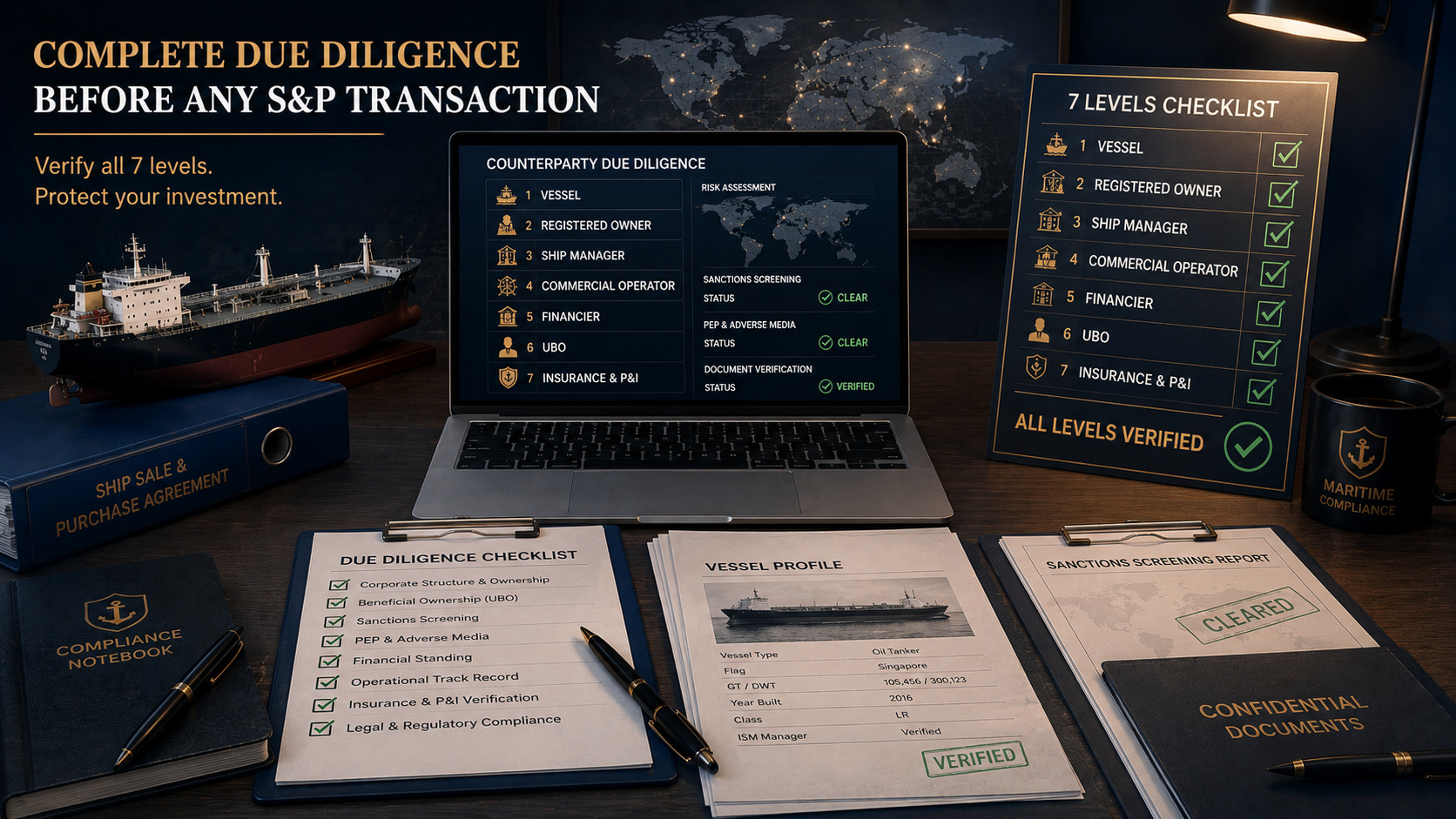
Theory without structure is just text. We therefore consolidate everything discussed above into a working matrix. It can be used as the basis of an internal compliance file for any S&P transaction.
| Level | Key Sources | Tools | Verification Timeline |
|---|---|---|---|
| Vessel | Classification society, PSC MoU | GISIS, Equasis, class | 3-5 days |
| Registered Owner | Flag State Registry, corporate registry | Agent in jurisdiction | 3-7 days |
| Ship Manager | Flag State DOC, PSC history | Equasis, Paris/Tokyo MoU | 2-3 days |
| Operator / Charterer | Charter Party, AIS history | MarineTraffic, VesselFinder | 3-5 days |
| Financing Bank | Flag State Mortgage Register | Request from flag state | 2-5 days |
| UBO | Corporate registries, PEP databases | World-Check, LexisNexis, ICIJ | 5-10 days |
| Insurer / P&I | P&I Club, H&M underwriter | LoU, claims history | 3-5 days |
Who conducts the verification:
- In-house compliance - for standard jurisdictions with transparent registries, where there is experience working with the specific flag
- External counsel - where offshore chains exceed two levels, in transactions involving parties from high-risk jurisdictions, and in the case of a first transaction with a new counterparty
When to initiate each level:
- Before signing the MoA - levels 1, 2, 6 (basic UBO screening)
- During the DD period (between MoA and delivery) - levels 3, 4, 5, 7
- Before delivery - repeat screening against sanctions lists. Lists are updated continuously - a verification is valid only as of the transaction date
The cost of a full seven-level due diligence for a mid-size tanker ranges from $8,000 to $25,000 depending on the jurisdictions and complexity of the structure. The cost of getting it wrong - a frozen asset worth $20-80 million and years of legal proceedings. The arithmetic is simple.
One Final Question
A vessel is an asset. The people behind it are the risk. Seven levels of verification are not the paranoia of an overcautious lawyer. They are the standard of practice for those who do not want to explain to investors why an asset is frozen and a deal is under investigation.
To summarize the key points:
- Technical due diligence is necessary, but not sufficient
- Every level of ownership requires separate verification with documented sourcing
- Sanctions screening is valid only as of the transaction date - repeat it before delivery
- A change of manager or operator prior to a sale is always a reason to ask questions
- A UBO chain without disclosure of the real beneficial owner is not standard practice. It is a reason to either get answers or walk away from the deal
Before any S&P transaction, it is worth asking yourself one simple question: "Do I know who the real owner of this vessel is?" Not the registered owner. Not the nominee director. But the individual in whose actual interests the entire structure exists.
If the answer is not obvious - the verification is not yet complete.
The team at Overhorn Swiss AG supports S&P transactions with full coverage across all seven levels of due diligence - from technical asset assessment to UBO chain verification. If you are preparing for a transaction or would like to discuss a specific situation, contact us.


